


2026 Fire Sprinkler Code Updates: The Bay Area Property Owner’s Compliance Guide
With homeowner assessments climbing as high as $3,000 per month for some residents, the financial weight of safety compliance has never felt more urgent. Many property owners feel overwhelmed by the shifting landscape of fire sprinkler code updates Bay Area officials have introduced for 2026. Between the new San Francisco Fire Code taking effect on January 1 and the proposed five-year pause on high-rise retrofit deadlines, it's difficult to know when you must actually break ground. You shouldn't have to choose between financial stability and the safety of your residents.
We're here to provide the professional oversight you need to secure your assets without the stress of regulatory guesswork. This guide clarifies the confusion surrounding the original 2027 permit deadlines and the potential shift to 2032. You'll gain a clear roadmap for navigating complex engineering requirements, including hydraulic calculations and system design. We'll also explain how to coordinate with the Bureau of Fire Prevention to ensure your property remains a safe, compliant sanctuary for years to come. Total certainty for every floor... Ready when you are...
Key Takeaways
Understand the updated compliance timeline, including the extension of the permit filing deadline to the end of 2031 for pre-1975 residential high-rises.
Learn how the latest fire sprinkler code updates Bay Area officials have implemented clarify the application of NFPA 13 versus NFPA 13R standards for residential projects.
Identify how California Fire Code Title 24 updates for 2026 will impact the engineering and design requirements for all new residential builds.
Discover a strategic roadmap for HOAs to conduct professional feasibility studies that help mitigate high assessment costs through precise system design.
Gain clarity on coordinating underground fire service with the SFPUC to ensure your building’s water supply meets modern suppression demands.
Table of Contents
The 2026 SF High-Rise Sprinkler Mandate: Deadlines and Extensions
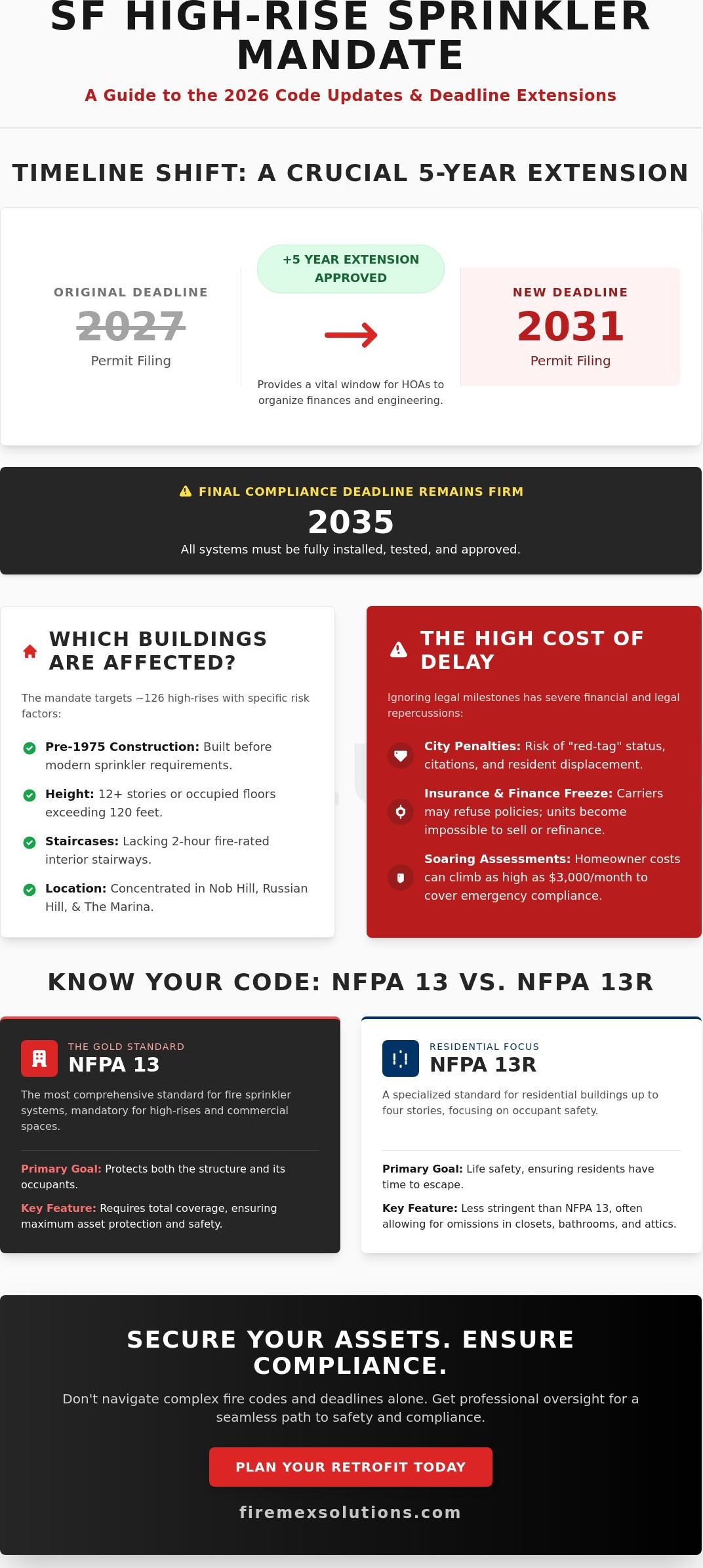
The 2022 San Francisco Fire Sprinkler Retrofit Mandate originally set a fast-paced schedule for high-rise safety. However, the Board of Supervisors recently adjusted the timeline to reflect the economic challenges facing property owners. In February 2026, officials approved a significant extension for the initial compliance phases. While the original law required building permits to be secured by 2027, owners now have until the end of 2031 to file their professionally designed drawings. This shift provides a vital window for HOAs to organize their finances and engineering strategies.
Despite this five-year pause on interim filings, the final compliance deadline remains firm. Every mandated fire sprinkler system must be fully installed, tested, and approved by the Fire Department by 2035. These fire sprinkler code updates Bay Area residents are monitoring show that while the city is flexible on the "how," they aren't budging on the "when" for total life safety. Relying on a future repeal is a dangerous strategy. Insurance carriers and lenders are already looking for proof of compliance before renewing policies or approving unit refinances. Early planning is the only way to avoid the rush as 2031 approaches. Total certainty for your assets starts with understanding these shifts today.
Which Buildings are Affected?
The mandate focuses on approximately 126 pre-1975 residential high-rises. These buildings typically stand 12 stories or higher, or have occupied floors exceeding 120 feet, and lack two-hour fire-rated interior staircases. You'll find the highest concentration of these properties in historic neighborhoods like Nob Hill, Russian Hill, and the Marina. If your structure fits these age and height criteria, the 2026 code updates apply directly to your property management roadmap.
The Cost of Non-Compliance
The SF Fire Department holds the authority to issue citations or even "red-tag" buildings that ignore these legal milestones. A red-tag status can lead to resident displacement and a total freeze on property transfers. Beyond city penalties, the impact on insurance is immediate. Many carriers won't write new policies for non-compliant high-rises, which can make individual condo units nearly impossible to sell. Compliance isn't just about safety; it's about protecting the marketability of every home in the building.
Key Fire Sprinkler Code Requirements for Bay Area Properties
Compliance depends heavily on the specific engineering standard assigned to your building. NFPA 13 remains the gold standard for high-rises and commercial spaces, providing comprehensive protection for both the structure and its occupants. Conversely, NFPA 13R is a specialized residential standard focused primarily on life safety in buildings up to four stories. These distinctions are vital as the California Building Standards Code updates for 2026 introduce stricter requirements for new construction. Staying ahead of these fire sprinkler code updates Bay Area mandates ensures your project avoids costly redesigns during the final permitting phase.
The SF Bureau of Fire Prevention manages local enforcement with a high level of scrutiny. They prioritize hydraulic reliability and precise head placement to ensure total coverage. Modern residential fire sprinkler systems now utilize concealed heads and custom finishes to blend seamlessly with high-end interior design. Safety doesn't have to compromise the beauty of your living space. Our team focuses on providing that invisible shield, ensuring your home remains a safe, elegant sanctuary. Total certainty for every room...
Commercial vs. Residential Standards
South San Francisco property owners face unique challenges depending on their occupancy type. Retail and restaurant spaces must adhere to specific fire load requirements that differ significantly from multi-family housing. If you're managing a business, reviewing commercial fire protection in South San Francisco is the best way to understand these localized rules. Commercial systems often require larger pipe diameters and specialized pumps to handle higher water demands.
Mandatory Inspection and Certification
Regular maintenance is the only way to guarantee system performance during an emergency. While annual visual checks are a baseline requirement, the 5-year confidence test is a rigorous pressure assessment of the entire piping network. In 2026, many older systems are failing certification due to internal pipe corrosion or painted-over sprinkler heads. Scheduling a professional fire sprinkler maintenance visit can identify these risks before they result in a failed city inspection. We're here to help you maintain a reliable defense against the unexpected.
Navigating Compliance: A Strategic Roadmap for HOAs
For many Homeowner Associations, the path to compliance feels like a financial maze. Success requires a disciplined, step-by-step approach that prioritizes engineering before excavation. The first phase involves a comprehensive fire system design and feasibility study. This initial investment determines if your current infrastructure can support the required suppression flow. It's the most effective way to avoid expensive mistakes during the construction phase.
Next, you must coordinate your underground fire service with the San Francisco Public Utilities Commission (SFPUC). This is often a complex stage, as it involves connecting to city water mains and potentially upgrading street-side pipes. To keep costs manageable, our engineers perform precise hydraulic calculations. These calculations ensure your system has adequate water pressure without the need for over-engineered, excessively large piping. By following these steps, you can secure your fire sprinkler inspection and permit approval well before the 2031 filing deadline. These fire sprinkler code updates Bay Area leaders have set are manageable when approached with a clear, professional strategy.
Engineering and Design Solutions
Modern technology offers ways to mitigate the high costs often cited in local news. We utilize 3D modeling to map out pipe routes that minimize ceiling drops and wall penetrations. This level of detail helps preserve the architectural integrity of your building and reduces material waste. When searching for a fire protection company near me, verify they hold a valid C-16 license. This certification ensures the contractor is legally qualified to design and install these life-saving systems.
Managing Repairs and Retrofits
Resident displacement is a major concern for HOAs during a retrofit. We recommend a phased installation strategy, working floor-by-floor to keep the building occupied and functional. If your building already has a partial system, you may need residential fire sprinkler repair in the Bay Area to bring existing components up to the 2026 standard. Addressing these repairs during the retrofit process is a cost-effective way to ensure total system reliability. We're committed to protecting your community with minimal disruption. Total certainty... every step of the way...
Securing Your Property’s Future with Expert Compliance
The 2031 permit deadline provides a vital window for property owners to move from confusion to certainty. By prioritizing professional feasibility studies and precise hydraulic calculations now, you protect your building from the risks of red-tagging and insurance loss. These fire sprinkler code updates Bay Area officials have implemented are high-stakes, but they don't have to be a source of constant stress. Compliance is a multi-year engineering project that preserves the long-term value of your assets while ensuring the safety of every resident.
Firemex Solutions Inc. brings over 20 years of specialized expertise to every project. As a C-16 Licensed Contractor, we provide comprehensive design-build capabilities specifically tailored for San Francisco high-rise and residential retrofits. We understand the local nuances of the Bureau of Fire Prevention and the SFPUC, acting as your dependable shield against regulatory complexity. We remain committed to the core values of honesty and hard work that have defined our industry tenure.
Your peace of mind is our priority. We're here to help you navigate these changes with confidence and professional oversight. Total certainty... for life and property...
Frequently Asked Questions
What is the new deadline for San Francisco high-rise sprinkler permits?
The proposed extension moves the permit filing deadline to the window of 2030 to 2032. Originally set for 2027, a San Francisco Board of Supervisors committee approved a five-year pause in February 2026 to help property owners manage the financial and logistical burden. It's important to remember that the final deadline for a fully operational and approved system remains 2035.
How much does a fire sprinkler retrofit typically cost in the Bay Area?
Total costs vary significantly based on a building's height, age, and existing infrastructure. Property owners should prepare for a substantial investment that covers professional system design, hydraulic calculations, and the installation of dedicated fire-water systems. Because these projects often require new underground service and specialized pumps, many HOAs are developing long-term financial strategies to manage the project scope effectively.
Do I need to move out of my condo during sprinkler installation?
You typically don't need to vacate your home during a phased installation. Professional contractors use strategic scheduling to work in specific zones or floors, which minimizes the time spent inside individual units. While you can expect some noise and temporary wall penetrations, a well-managed project allows residents to remain in place throughout the construction process with minimal disruption to their daily lives.
What is a 5-year fire sprinkler certification and is it required?
A 5-year certification is a mandatory, rigorous inspection required by NFPA 25 and the California Fire Code. Unlike annual visual checks, this process involves pressure testing the piping and checking internal components for corrosion or obstructions. It's a vital part of the fire sprinkler code updates Bay Area property owners must follow to maintain their insurance eligibility and legal compliance.
Can I use my existing water line for a new fire sprinkler system?
Most pre-1975 high-rises have water lines that are inadequate for a full-building automatic suppression system. These structures usually require a new, dedicated fire-water service, which may include storage tanks, booster pumps, and backup generators. A professional feasibility study is the only way to determine if your current underground service can meet modern safety standards and flow requirements.
Who is responsible for the cost of the SF sprinkler mandate?
The building owner or Homeowner Association is legally responsible for funding the mandate. In multi-unit condo buildings, this often involves special assessments for individual owners. Some residents have reported monthly assessments between $1,000 and $3,000 to cover these safety upgrades. It's important to consult with your board to understand the specific financial roadmap and engineering timeline for your building's compliance.
Comments