


2026 Bay Area Garage Fire Sprinkler Compliance Guide
With the rise of electric vehicle charging and evolving 2026 California Building Codes, your garage is no longer just a storage space; it's a high-stakes fire safety zone. Many Bay Area property owners feel overwhelmed by the shifting line between NFPA 13D residential standards and the more rigorous NFPA 13 commercial rules. It's natural to feel anxious about failing a mandatory inspection or managing the costs of retrofitting an older San Francisco structure. This guide clarifies the complex fire sprinkler requirements for a garage to ensure your property remains both legal and protected.
We provide a clear roadmap for navigating the latest CBC updates and NFPA standards. You'll learn exactly when a C-16 licensed contractor is required for your project and how to secure a reliable system certification. Our goal is to provide the expert oversight you need for total certainty and safety.
Table of Contents
Residential vs. Commercial: When Are Garage Sprinklers Required?
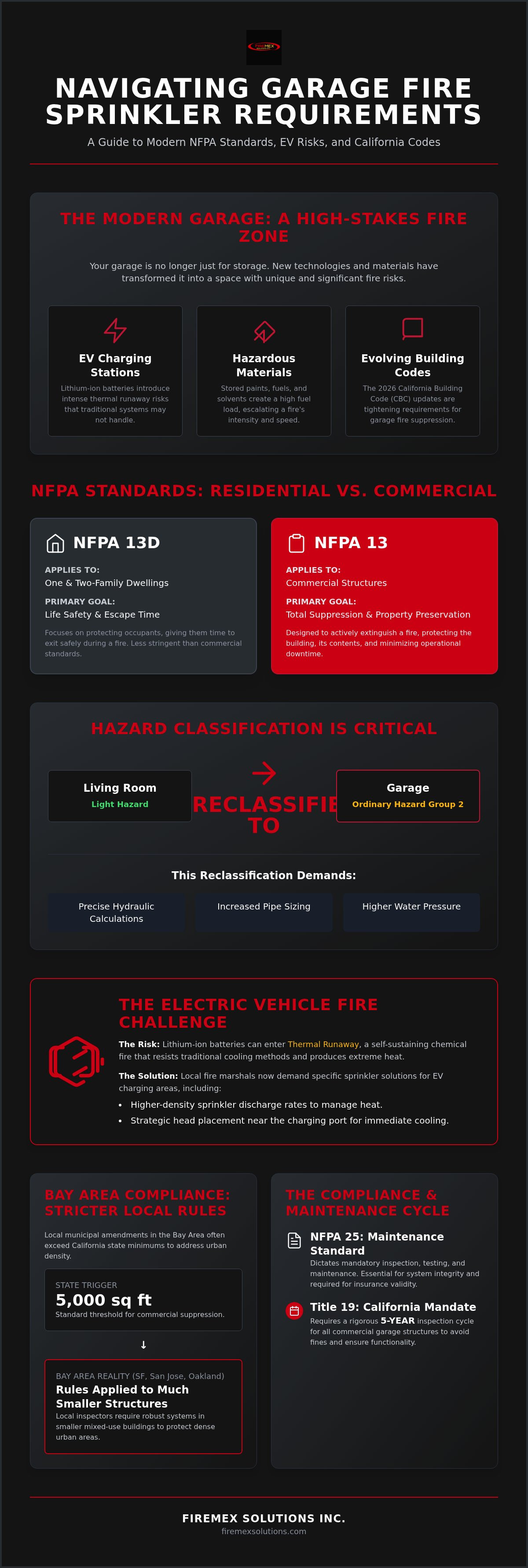
Determining the correct protection level starts with identifying your occupancy classification. NFPA 13D standards apply to one- and two-family dwellings, focusing on life safety and escape time. Conversely, NFPA 13 governs commercial structures where the goal is total fire suppression and property preservation. The 2021 International Building Code (IBC) update significantly tightened these rules. Open parking garages, classified as Group S-2 occupancies, now require full protection due to increased vehicle fire risks. In the Bay Area, the California Building Code (CBC) mandates that most new attached residential garages include active suppression systems.
Many property owners underestimate their risk level. While a living room is often Light Hazard, a garage filled with paints, solvents, and fuel is typically reclassified as Ordinary Hazard Group 2. This distinction changes everything from pipe sizing to water pressure needs. Meeting the fire sprinkler requirements for a garage doesn't just mean hanging heads; it requires precise hydraulic calculations to handle these higher fuel loads. A professional fire sprinkler system design ensures your system can handle a fast-moving blaze before it reaches the main living or commercial areas.
The Impact of Electric Vehicles (EVs) on Garage Safety Requirements
Lithium-ion batteries introduce intense thermal risks that are reshaping local fire marshal requirements. When an EV battery fails, it can enter thermal runaway, a self-sustaining chemical fire that resists traditional cooling methods. This hazard demands higher-density sprinkler discharge rates to manage the extreme heat output. Local Bay Area jurisdictions are increasingly scrutinizing fire sprinkler requirements for a garage that houses high-speed charging stations. For maximum safety, your sprinkler head must be positioned within a specific radius of the vehicle's charging port to ensure immediate cooling during an incident.
Compliance Standards for San Francisco Bay Area Garages
California state code provides a baseline, but local jurisdictions like San Francisco, San Jose, and Oakland often implement stricter amendments to address urban density. While the standard building code triggers suppression needs at a 5,000 square foot threshold for commercial fire areas, local Bay Area inspectors frequently apply these rules to much smaller mixed-use structures. Meeting the fire sprinkler requirements for a garage in these cities means accounting for specific municipal codes that state-level guidelines might overlook. This localized oversight ensures that even compact urban garages possess the necessary suppression power to prevent a single vehicle fire from threatening an entire city block.
For property managers, compliance is a continuous cycle defined by the NFPA 25 standard. This regulation dictates the mandatory inspection, testing, and maintenance of all water-based fire protection systems. Maintaining these records is vital because a professional fire sprinkler inspection is often a prerequisite for insurance validity. Carriers look for these academic-grade reports to confirm that the property is adequately shielded against catastrophic loss. Without this documented proof, you risk both legal penalties and the denial of claims following an incident.
Mandatory Inspection and Certification Cycles in California
Title 19 mandates a rigorous five-year inspection cycle for all commercial garage structures in California. This process involves a deep dive into the system's mechanical integrity, including the underground fire service and head functionality. Preparing for a fire marshal walkthrough in a residential multi-family complex requires meticulous organization and a system that fully aligns with the fire sprinkler requirements for a garage. Leveraging local commercial fire protection expertise is the most effective way to avoid hefty fines and operational delays. It's the best way to ensure your property remains a safe haven for residents and assets alike.
Designing and Installing Your Garage Sprinkler System
Engineering a robust suppression system requires more than simple pipe fitting. The fire sprinkler system design process involves complex hydraulic calculations that account for garage floor slope and varying ceiling heights. These factors dictate how water flows and where pressure might drop. Selecting the appropriate hardware is equally critical. While quick-response heads provide rapid activation for life safety, standard-response heads are often better suited for unheated garage spaces where temperature fluctuations occur. Proper hardware selection ensures the system meets the specific fire sprinkler requirements for a garage without risk of accidental discharge.
Permit approval in Peninsula cities like San Mateo or Palo Alto requires the stamp of a C-16 licensed contractor. Local building departments demand proof that your system aligns with both state codes and municipal water pressure standards. For new detached garage constructions, integrating a dedicated underground fire service is essential. This separate line guarantees that the garage suppression system has a reliable, high-volume water source independent of the primary residence. It’s a foundational step in creating a property that stands as a fortress against fire.
Retrofitting and Design Considerations for SF Homes
Retrofitting older San Francisco structures presents unique challenges, particularly regarding limited overhead clearance and historical architectural constraints. We specialize in installing residential fire sprinkler systems that utilize low-profile piping and concealed heads to maintain a home's aesthetic value. This approach ensures your safety doesn't come at the expense of your property’s interior design. California Health and Safety Codes strictly prohibit DIY installation of these systems to ensure every component functions perfectly under pressure.
Secure Your Property with 2026 Compliance Standards
We've explored the critical differences between residential and commercial classifications, the impact of EV charging on safety codes, and the necessity of specialized hydraulic design for sloped ceilings. Understanding the fire sprinkler requirements for a garage is the first step toward total certainty for your assets and family. Firemex Solutions Inc. stands as your reliable guardian with over 20 years of industry experience serving the Bay Area. As C-16 licensed experts, we provide full design, installation, and certification services tailored to the unique municipal amendments of San Francisco, San Jose, and Oakland. Don't leave your property's safety to chance when expert oversight is a phone call away. Secure Your Bay Area Property with Expert Firemex Solutions Inc. today. Protecting your legacy starts with a commitment to academic-grade safety standards and a partner who prioritizes your security above all else.
Frequently Asked Questions
Do I need fire sprinklers in a detached residential garage?
Most detached residential garages don't require sprinklers under the California Building Code unless they're converted into habitable spaces or exceed local square footage limits. However, local fire marshals in cities like San Francisco may enforce stricter rules if the structure sits close to property lines. It's best to check your specific municipal permit requirements before starting a new build.
What is the difference between Ordinary Hazard Group 1 and Group 2 for garages?
The primary difference lies in the combustible load and expected heat release rate. Ordinary Hazard Group 1 covers areas with low combustibility, such as simple parking areas. Group 2 is designated for spaces with moderate to high fuel loads, including garages used for vehicle repair or storing flammable solvents. This classification determines the required water density for your fire sprinkler requirements for a garage.
Are fire sprinklers required if I install an EV charging station in my garage?
Current California codes don't always trigger a retrofit for existing garages just for adding a charger. However, many Bay Area fire departments now require enhanced suppression for new construction or major renovations involving EV stations. The intense heat of lithium-ion battery fires often necessitates a system designed for higher discharge rates to ensure the structure remains protected during a thermal runaway event.
How much does it cost to retrofit a garage with fire sprinklers in the Bay Area?
Retrofit costs vary significantly based on your existing plumbing infrastructure, ceiling accessibility, and the specific fire sprinkler requirements for a garage in your municipality. Factors like whether you need an underground fire service or a booster pump will influence the final investment. We recommend a professional site evaluation to determine the most efficient path toward full code compliance and property safety.
Can I use an anti-freeze system for a garage sprinkler in colder Bay Area microclimates?
You can use anti-freeze, but it must be a specifically listed, non-toxic solution according to current NFPA standards. Many Bay Area property owners in colder microclimates opt for dry-pipe systems or heat-tracing on wet pipes to prevent freezing. These methods ensure the system remains functional during rare frost events without the maintenance complexities of specialized chemical mixtures.
Does a garage fire sprinkler system require its own separate water line?
Residential systems under NFPA 13D often share a water supply with the home's domestic line, provided the pressure is sufficient. Larger commercial garages or detached structures usually require a dedicated underground fire service to meet hydraulic demands. This separate line ensures that a fire incident has access to the full volume of water needed for suppression without competing with other household fixtures.
Comments