


Sprinkler System Fire Protection: The Complete Bay Area Property Owner’s Guide
A professionally installed sprinkler system fire setup reduces property loss by an average of 71% per incident according to current safety data. While that statistic is reassuring, many Bay Area owners still feel a deep sense of anxiety regarding accidental water damage or the complexity of the 2025 San Francisco Fire Code. It's natural to feel overwhelmed by the technical demands of high-stakes safety. We believe you deserve a dependable shield that protects your assets without the stress of compliance confusion, ensuring your peace of mind with every installation from Firemex Solutions Inc.
In this guide, you'll learn exactly how these precision-engineered systems safeguard your property and how to execute an emergency shut-off with confidence. We provide a clear roadmap for navigating the 2025 California Fire Code and the specific deadlines associated with the San Francisco High-Rise Sprinkler Retrofit Mandate, known as Ordinance File #220038. You'll discover the essential maintenance cycles required by the NFPA 13E 2026 edition to ensure your system remains a reliable guardian for years to come, making complex safety straightforward.
Key Takeaways
Understand how individual head activation provides a precise response, dispelling the common myth that all heads trigger simultaneously during a fire.
Learn why consistent maintenance of your sprinkler system fire setup is a critical legal and safety requirement for San Francisco property owners.
Discover the essential testing protocols for valves, backflow preventers, and flow alarms that guarantee your system meets strict California codes.
Identify why professional design and hydraulic calculations are mandatory for new construction and major renovations in San Jose and Oakland.
Table of Contents
The Mechanics of a Sprinkler System Fire Response: Beyond the Myths
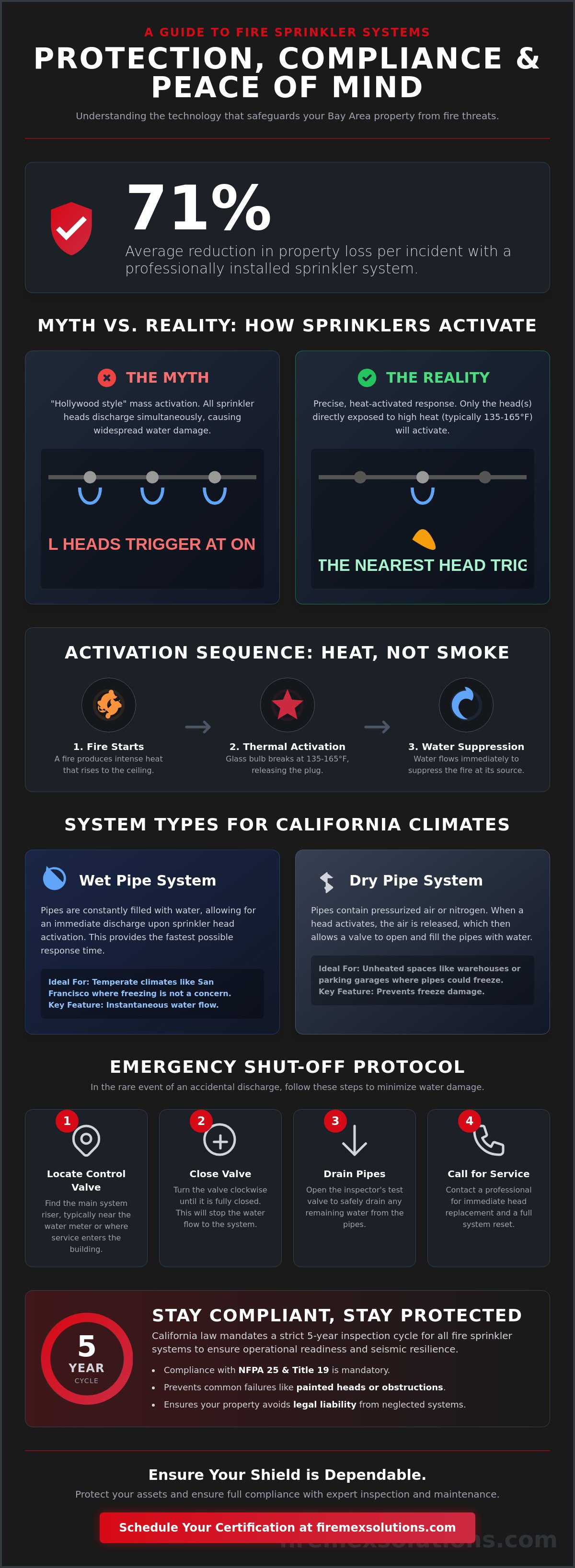
A fire sprinkler system is a sophisticated active fire protection method. It consists of a dedicated water supply that provides constant pressure to a network of distribution piping throughout your property. Hollywood myths are misleading. Many people believe every head in a building activates at the same time. This isn't true. In a real-world sprinkler system fire scenario, only the individual head closest to the heat source opens. This targeted response minimizes water damage while maximizing suppression where it's needed most. Expert oversight...
The activation relies on a thermal trigger. Each head contains a glass bulb or a metal fusible link designed to react to specific temperatures, typically between 135 and 165°F. When the heat reaches this threshold, the seal breaks and water flows immediately. By controlling heat, smoke, and flames at the origin, these systems act as a Reliable Guardian for your property. They provide the critical minutes needed for the SF Fire Department to arrive. Understanding how fire sprinkler systems work helps property owners appreciate the engineering behind their safety. Total certainty...
Thermal Activation vs. Smoke Detection
Smoke, burnt toast, or dust cannot trigger a fire sprinkler; only high heat can. A smoke alarm is a detection tool meant to alert occupants. A sprinkler is a suppression tool designed to physically control the flames. They perform different roles but work together to provide a dependable shield for your assets.
Wet Pipe vs. Dry Pipe Systems in California
Wet pipe systems are the standard choice for San Francisco's temperate climate. The pipes remain filled with water at all times for an instant response. In contrast, dry pipe systems are used in unheated spaces like warehouses where freezing is a risk. These systems hold pressurized air in the pipes until a head activates. Once the air escapes, the water follows. This ensures a reliable sprinkler system fire defense even in colder environments.
Managing Your System: Maintenance, Inspections, and Emergency Protocols
Owning property in the Bay Area involves high-stakes responsibility. A non-functional system isn't just a safety risk. It's a significant legal liability. If a sprinkler system fire event occurs and the hardware fails due to neglect, the property owner faces severe consequences. Compliance isn't a suggestion. It's a commitment to security. Regular testing of valves, backflow preventers, and water flow alarms ensures the system responds when it counts. Safety requires expert oversight.
Common failure points often stem from simple oversights. Painted-over heads or pipes obstructed by storage can cripple a system's effectiveness. These issues are easy to miss during daily operations but fatal during an emergency. If you notice these deficiencies, it's vital to seek residential fire sprinkler repair Bay Area services immediately. Addressing small problems early maintains your dependable shield and ensures total certainty.
What to Do During a False Discharge or Leak
Accidental discharges are rare but stressful. Stay calm. Follow these steps to mitigate water damage:
Locate the main control valve. It's usually found near the water meter or the system riser.
Close the valve to stop the water flow immediately.
Open the inspector's test valve to drain the remaining water in the pipes.
Contact a fire sprinkler repair near me for rapid head replacement and a professional system reset.
California Compliance: NFPA 25 and Title 19
California law mandates a strict 5-year inspection cycle for all systems. These Bay Area sprinkler regulations ensure seismic resilience and operational readiness. A professional fire sprinkler inspection differs between commercial and residential properties. Commercial sites require frequent testing of fire pumps and complex components. Residential inspections focus on head integrity and supply lines. You can schedule a certification to ensure your property remains compliant and protected.
Professional Sprinkler Solutions: Ensuring Compliance and Protection in the Bay Area
Bay Area construction requires more than just standard plumbing. Professional residential fire sprinkler systems design is a legal necessity for new builds and major remodels in San Jose and Oakland. This process involves sophisticated hydraulic calculations to confirm your water supply can handle the specific demand of the system. Without this engineering precision, your sprinkler system fire response might fail when it's needed most. We believe in providing a dependable shield that meets every regulatory hurdle. Total certainty...
Hiring a C-16 licensed contractor is the only way to ensure your installation meets these high-stakes standards. These specialists understand the gravity of fire safety. They also respect your property's aesthetic. For high-end San Francisco interiors, we utilize concealed sprinkler heads that remain flush with the ceiling. This Reliable Guardian approach ensures your protection is invisible until the moment it's required. Safety doesn't have to compromise design. Constant availability...
Seismic Requirements for Bay Area Systems
San Francisco's geography demands localized expertise. Seismic activity can easily rupture rigid piping. To prevent this, we install flexible couplings and specialized sway bracing. These components allow the system to move with the building during an earthquake. Adhering to local seismic codes is non-negotiable for ensuring the longevity and reliability of your sprinkler system fire defense.
Commercial vs. Residential Design Standards
Design standards are not one-size-fits-all. Your commercial fire protection needs will differ significantly from a home setup. Commercial systems require much higher water density and broader coverage areas to protect large-scale assets. We follow specific NFPA guidelines to match the occupancy type:
NFPA 13: The comprehensive standard for commercial fire suppression.
NFPA 13R: Specific requirements for multifamily residential housing.
NFPA 13D: Guidelines for one- and two-family dwellings.
Choosing the correct standard ensures your system is both compliant and cost-effective. Expert oversight...
Securing Your Property’s Future with Precision Engineering
Your property deserves a dependable shield that stands up to both fire emergencies and seismic shifts. By understanding that a sprinkler system fire response is a localized, heat-activated event, you can move past common myths and focus on real protection. Compliance with California Title 19 and NFPA standards isn't just about avoiding fines. It's about ensuring your system remains a Reliable Guardian for your assets and the lives within your building. Safety simplified...
Navigating the complex landscape of San Francisco fire codes requires a partner with deep local expertise. We bring over 20 years of Bay Area fire protection experience to every project. As a fully licensed C-16 contractor, we specialize in the design, maintenance, and certification of high-stakes safety systems. You don't have to manage these technical requirements alone. Expert oversight...
Protect your property with Firemex Solutions Inc.-Schedule your SF inspection today!
Total certainty is within reach. We're here to provide the expert oversight you need to maintain a safe, compliant, and resilient property. Constant availability...
Frequently Asked Questions
Will a single sprinkler head going off cause water damage to my entire house?
No, only the head directly exposed to high heat will activate. In a real-world sprinkler system fire scenario, a single head is usually sufficient to suppress the flames. This localized response prevents the widespread water damage often depicted in cinema. Your property stays protected without the risk of unnecessary flooding. Total certainty...
How often do I need to have my fire sprinkler system inspected in San Francisco?
California Title 19 mandates a comprehensive inspection every five years. While this is the legal minimum, many San Francisco property owners opt for annual visual checks to ensure no heads are obstructed. Maintaining this schedule ensures your system remains a Reliable Guardian for your assets. Regular oversight is key to long-term safety. Safety simplified...
Can I paint over my fire sprinkler heads to match my ceiling?
You must never paint over your sprinkler heads. Paint acts as an insulator that can delay the thermal trigger or physically prevent the head from opening. If a head is painted, it's considered non-functional and must be replaced to maintain compliance with NFPA 25 standards. We recommend using concealed heads if aesthetic matching is a priority. Expert oversight...
What should I do if my fire sprinkler system starts leaking?
Shut off the main control valve immediately to stop the water flow. Once the valve is closed, open the inspector's test valve to drain any water left in the sprinkler system fire pipes. This prevents further damage while you wait for a technician. Quick action is essential to protecting your property's interior and structural integrity. Constant availability...
Do residential fire sprinklers require a separate water tank?
Most homes in South San Francisco don't require a separate water tank. The system usually draws directly from the municipal water line. We only recommend tanks or booster pumps if our hydraulic calculations show that the local water pressure is insufficient for the system's design. This ensures your protection is both efficient and reliable. Safety simplified...
How much does a fire sprinkler system cost for a new home in the Bay Area?
Costs depend on the specific square footage and the complexity of your building's layout. New construction typically allows for more straightforward piping installation compared to retrofitting older Victorian homes. We provide detailed estimates that factor in local San Francisco permit requirements and engineering needs to ensure your budget is respected. Professional oversight...
Comments