


Understanding NFPA 25: The SF Bay Area Property Owner’s Guide to Compliance
Your fire sprinkler system is more than just hardware in the ceiling; it's your property’s primary legal shield, and in the San Francisco Bay Area, maintenance "grandfathering" simply doesn't exist. While the national standard recently updated to the 2026 edition, local compliance still hinges on the nfpa 25 2013 California Edition as enforced by the 2025 San Francisco Fire Code. We understand that balancing these technical mandates with the fear of legal liability or system failure is a constant source of stress for property owners.
We're here to provide the quiet confidence that comes from expert oversight and reliable protection. This guide will help you master the essentials of nfpa 25 to ensure your system remains operational and ready to protect your assets. You'll gain a clear understanding of required inspection frequencies, learn how to navigate SFFD permit fees that changed on September 1, 2025, and discover how documented compliance can lower your insurance premiums. We will break down exactly what you need to do to stay legal and safe in the City by the Bay.
Key Takeaways
Understand why nfpa 25 places the legal responsibility for fire system safety directly on the building owner rather than the contractor.
Distinguish between the three pillars of fire safety-inspection, testing, and maintenance-to ensure your system is always ready.
Learn which visual checks you can manage monthly and which complex five-year certifications require a licensed C-16 professional.
Discover how maintaining meticulous records protects you from SFFD citations and potential insurance claim denials after an emergency.
Gain the confidence to meet local Bay Area amendments and protect what matters most through proactive compliance.
Table of Contents
What is NFPA 25 and Why Does it Govern Your Fire Safety?
The National Fire Protection Association (NFPA) establishes the rigorous safety standards that protect lives across the globe. Specifically, nfpa 25 serves as the baseline for inspecting, testing, and maintaining water-based fire systems. Think of it as the mandatory roadmap for residential fire sprinkler systems to ensure they work when needed. It's the technical bible that keeps your protection active long after the initial installation is complete.
This document is often called the "Owner's Standard." While licensed contractors perform the physical work, the legal burden of safety rests squarely on the building owner's shoulders. According to the 2013 California Edition of the code, you're responsible for keeping the system in proper operating condition. This proactive approach eliminates the stress of potential failure during an emergency and ensures you're Always Ready for any inspection. By following these rules, you maintain 100% confidence in your property’s safety.
The Difference Between NFPA 13 and NFPA 25
Confusion often arises between these two standards. NFPA 13 governs the design and installation of new systems. Once the certificate of occupancy is issued, nfpa 25 takes over for the life of the building. You can't assume a brand-new installation exempts you from immediate requirements. In fact, certain visual inspections must begin as soon as the system is active to ensure the hardware remains in peak condition. We provide the expert oversight needed to transition from construction to long-term compliance seamlessly.
Why Grandfathering Doesn't Exist in Maintenance
Many property owners in San Francisco, San Jose, and Oakland believe older systems are exempt from modern rules. This is a dangerous misconception. Unlike installation codes, NFPA 25 has no retroactivity clause. Fire safety components like rubber seals and sprinkler heads degrade over time; a 50-year-old valve is just as likely to fail as a newer one if neglected. Every system must meet current maintenance standards to ensure we are Protecting What MatterS Most on your property. Regular ITM is the only way to prove your system is still capable of performing its life-saving mission.
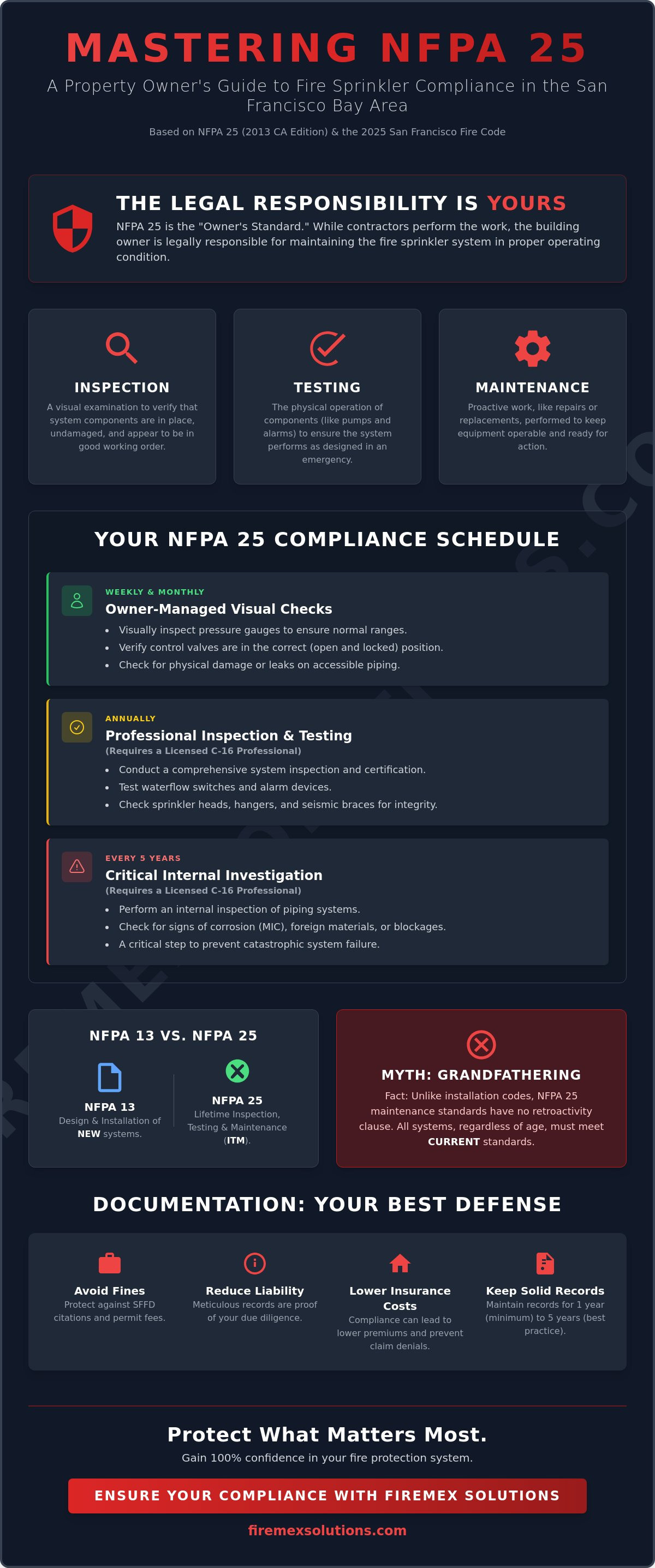
The NFPA 25 ITM Schedule: Requirements for Weekly to 5-Year Inspections
Compliance requires a clear understanding of the three pillars of fire safety: inspection, testing, and maintenance. Inspection is a visual examination to ensure components are in place and undamaged. Testing involves physical operation to confirm the system performs as designed. Maintenance is the proactive work needed to keep everything operational. The official NFPA 25, Standard for the Inspection, Testing, and Maintenance of Water-Based Fire Protection Systems details exactly how often these actions must occur to keep your property safe.
Owners can often handle weekly and monthly tasks themselves. These are primarily visual checks of pressure gauges and ensuring control valves are locked in the open position. However, once a year, a professional must conduct a comprehensive fire sprinkler inspection to certify the system. This annual check ensures every component is ready to react. Every five years, the code mandates a deep-dive internal investigation. Technicians look inside the piping for signs of corrosion or debris that could block water flow during an emergency. It's a critical step to ensure you are Always Ready...
Common Components Covered Under NFPA 25
In the Bay Area, seismic braces are critical. We check these alongside sprinkler heads, hangers, and piping to ensure stability during a tremor. Larger commercial buildings also require rigorous testing of fire pumps and water storage tanks. We also verify that waterflow switches and alarm devices are functional. These components are what alert the SFFD when a head activates, making their reliability non-negotiable for life safety. Our team ensures every part meets the standard for 100% confidence.
The Importance of Documentation and Record Keeping
Meticulous records are your best defense against liability. California law requires you to maintain ITM records for at least one year or until the next scheduled test. However, keeping a five-year history is a best practice that provides peace of mind during a surprise fire marshal visit. Digital records protect you from claim denials after a fire event by proving you met your legal obligations. If you aren't sure where your current records stand, our team can help you get organized and compliant with A+ service.
Compliance and Liability: Why Your NFPA 25 Records Matter in the Bay Area
In San Francisco, compliance isn't just a suggestion; it's a strictly enforced legal requirement. The San Francisco Fire Department (SFFD) and other regional agencies use these standards to conduct audits and issue citations. Meticulous record-keeping is your primary defense during these inspections. Resources like the guide on Understanding NFPA 25 clarify that the burden of proof lies with the property owner. Without documented proof of testing, you face heavy fines and potential building closures.
Beyond the fire marshal, your insurance provider relies on these records. If a fire occurs and you lack current nfpa 25 documentation, the carrier may deny your claim entirely. This represents a massive financial risk that can be avoided through disciplined maintenance. We view this standard as a vital tool for Protecting What MatterS Most!-your employees, your tenants, and your physical assets. In fact, commercial fire protection compliance in 2026 hinges on proactive NFPA 25 adherence.
What Happens During a Failed Inspection?
If an inspector finds an issue, they'll categorize it as either a deficiency or an impairment. A deficiency is a non-critical issue that needs correction, while an impairment is an urgent threat that renders the system non-functional. Impairments require immediate action to avoid a "Fire Watch" or building evacuation. You can quickly transition from a failed report to a professional fire sprinkler repair near me to maintain your coverage and safety status. We stay Always Ready... to help you resolve these issues quickly.
Choosing a Qualified NFPA 25 Contractor
Not every plumber or general contractor is qualified to sign off on your fire safety. A C-16 Fire Protection license is a non-negotiable requirement for anyone performing this work in California. We bring over 20 years of local experience to every job, helping you navigate the unique city codes of the Bay Area with A+ service. Choosing a partner with deep regional expertise gives you 100% confidence that your property remains safe and fully compliant with all state and local mandates.
Take Command of Your Fire Safety Today
Staying ahead of complex fire codes doesn't have to be a source of stress. By mastering the nfpa 25 schedule and understanding the critical difference between a minor deficiency and a major impairment, you've already taken the first step toward total property protection. Your documentation remains your strongest defense against SFFD citations and insurance complications. Whether you're managing a historic residential high-rise or a modern commercial space, consistent maintenance is the only way to ensure your system performs when it matters most.
Firemex Solutions Inc. brings over 20 years of local expertise to every inspection. As licensed C-16 Fire Protection Contractors, we provide the technical precision and A+ service required to keep your certifications current and your building safe. We are Always Ready... for emergency repairs and comprehensive system testing, giving you 100% confidence in your safety strategy. Schedule your NFPA 25 compliance inspection with Firemex Solutions Inc. today!
Taking proactive steps now prevents costly surprises later. We are here to serve as your dependable shield, helping you focus on your business while we handle the technical details of Protecting What MatterS Most!
Frequently Asked Questions
What is the difference between an inspection and a test under NFPA 25?
An inspection is a visual examination of your system to ensure components are in place and free from physical damage. A test is a physical operation of the system to confirm it functions exactly as intended. For example, looking at a pressure gauge to see if it’s in the correct range is an inspection. Opening a test valve to see if the waterflow alarm triggers is a test.
Both are required to maintain your certification. While owners can perform some visual inspections, most physical tests require a licensed professional to ensure no damage occurs to the property during the process.
Are single-family homeowners in the Bay Area required to follow NFPA 25?
No, the nfpa 25 standard specifically excludes one- and two-family dwellings. These smaller residential properties are typically governed by NFPA 13D guidelines at the time of installation. While we recommend that homeowners perform basic maintenance to ensure safety, they aren't subject to the rigorous ITM schedules or SFFD reporting mandates that apply to commercial and multi-unit residential buildings.
If you own a property with a newly constructed Accessory Dwelling Unit (ADU), you should consult local San Francisco ordinances. Some local amendments may require specific oversight for these structures to ensure they meet regional safety goals.
How often does the NFPA 25 standard get updated?
The national standard is updated every three years to reflect new technology and safety data. The newest version is the 2026 Edition, which introduces guidelines for sprinklers in units over 50 years old. However, California law often adopts these changes on a delayed cycle. As of May 2026, the legally enforced version in our state remains the 2013 California Edition.
This gap between national and state standards is why local expertise is vital. We ensure your building meets the specific version of the code that the SFFD uses for its current enforcement and permitting process.
Who is legally responsible if a fire sprinkler system fails to activate?
The building owner is legally responsible for the maintenance and performance of the fire protection system. Even if you hire a contractor, the 2025 San Francisco Fire Code states that the owner must ensure the system remains in proper operating condition. If a failure occurs and you don't have proof of recent nfpa 25 compliance, you may face significant legal liability.
Maintaining a clear digital or paper trail of your inspections is your best protection. These records prove you took every required step to keep your property safe, which is essential for defending against insurance claim denials or legal challenges after an emergency.
Comments