


Understanding Your Fire Sprinkler Inspection Report: A Bay Area Property Owner’s Guide
- 15 hours ago
- 7 min read
Did you know that property damage is, on average, 80% lower in buildings equipped with working fire sprinklers? While that statistic offers peace of mind, the dense stack of paperwork you receive after a professional visit often does the opposite. If you're like most Bay Area property owners, understanding your fire sprinkler inspection report feels like trying to translate a foreign language filled with NFPA codes and technical jargon. It's common to feel a sense of urgency or even anxiety when you're staring at a list of deficiencies and wondering which ones are critical for passing a fire marshal audit.
We believe that safety shouldn't be stressful. This guide will help you decode complex technical terms, distinguish between urgent repairs and minor maintenance, and establish a clear path toward official system certification. You'll gain the clarity needed to prioritize your budget while staying compliant with the 2025 San Francisco Fire Code and the latest 2026 NFPA 25 requirements. We'll show you how to transform that confusing document into a reliable roadmap for protecting your assets and the lives within them.
Table of Contents
The Anatomy of a Fire Sprinkler Inspection Report
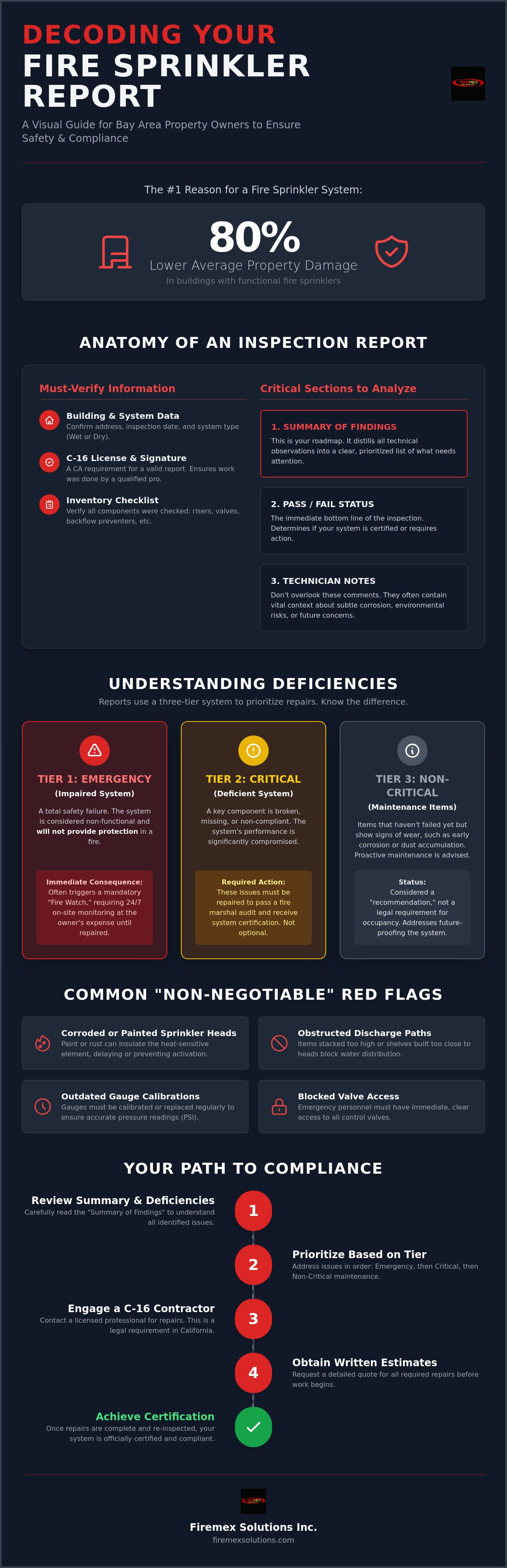
A fire sprinkler inspection report is far more than a simple service receipt. It serves as the official legal record of your system's health and its ongoing compliance with NFPA 25 standards. This document is your primary shield during a Fire Marshal audit, proving that you have met your obligations as a responsible property owner. When you begin understanding your fire sprinkler inspection report, start with the header. This section contains vital building data, the inspection date, and identifies whether you are operating a wet or dry fire sprinkler system. In California, a report is only valid if it features the technician's signature and a verified C-16 license number, signaling that the work was performed by a qualified professional.
The most critical area for any owner is the "Summary of Findings." This section distills complex engineering observations into a clear list of results. It acts as a roadmap for your maintenance strategy, highlighting exactly what needs attention to keep your building safe. Without a clear summary, a report is just a collection of data points; with it, you have a functional tool for asset management.
Key Sections Every SF Property Owner Should Check
Locate the "Pass/Fail" status immediately. While this gives you the bottom line, the "Inventory" section provides the supporting evidence. This list should confirm that the technician checked every riser, valve, and backflow preventer on your property. Don't skim over the technician notes. These brief, handwritten or typed comments often contain the most important safety context, such as subtle signs of corrosion or environmental factors that could impact your system's reliability in the future.
Decoding Technical Terminology and NFPA 25 Codes
Technical reports often use industry shorthand that can be confusing. You will frequently see "AHJ," which stands for Authority Having Jurisdiction, typically your local fire department. "PSI" refers to Pounds per Square Inch, a measurement of the water pressure currently in your lines. NFPA 25 is the baseline for fire sprinkler safety and compliance across the United States. When your report cites a specific code, it's referencing this national standard to explain why a certain component passed or failed its mandatory check.
Identifying Deficiencies: Critical vs. Non-Critical Issues
Once you've located the summary section, understanding your fire sprinkler inspection report requires a clear grasp of how technicians categorize their findings. Most modern reports use a three-tier system: Emergency, Critical, and Non-Critical. An Emergency finding means the system is "impaired" and cannot provide protection during a fire. A Critical deficiency indicates a component is broken or missing, though the system might still partially function. Non-Critical findings are usually maintenance items that haven't reached a failure point yet but will eventually compromise the system's longevity.
Bay Area fire marshals make a sharp distinction between an impaired system and a deficient one. An impairment is a total safety failure that often triggers an immediate "Fire Watch," requiring building owners to pay for 24/7 physical monitoring until the system is online. A common objection we hear is why an inspector flagged an issue that seemed fine last year. The reality is that corrosion and dust accumulation are progressive. A sprinkler head might have been borderline twelve months ago, but it has now crossed the threshold into a safety violation under the 2026 NFPA 25 standards.
Common Red Flags in Bay Area Residential Systems
Corroded heads and obstructed discharge paths are the most frequent "non-negotiable" repairs we see in local homes. If a sprinkler head is covered in paint or dust, it won't activate at the correct temperature. You can learn more about how we resolve these specific issues in our guide to residential fire sprinkler repair Bay Area. Other common red flags include outdated gauge calibrations and blocked valve access, which are simple fixes that often stand between you and a passing certification.
Why Some Issues Require Immediate Repair
It's vital to distinguish between a "Recommendation" and a "Requirement" for building occupancy. A recommendation might suggest a system upgrade for better performance, but a requirement is a legal mandate. Ignoring these leads to significant financial risk. A failed report can lead to the cancellation of your property insurance or leave you legally liable if an incident occurs. Total Certainty... that is what we aim to provide with every assessment. If you need help prioritizing your next steps, Firemex Solutions Inc. offers expert fire sprinkler maintenance to ensure your property remains a safe haven.
From Report to Resolution: Your Next Steps for Compliance
The journey from receiving a failed report to holding a passing certification is a structured process designed to protect your building and its occupants. Understanding your fire sprinkler inspection report is just the first phase; the second is taking decisive action to clear any noted violations. We recommend following these four steps to ensure your system returns to full compliance without unnecessary delays.
Step 1: Review the findings with a C-16 contractor. Don't try to tackle the list alone. Sit down with a professional to prioritize "Emergency" items that compromise life safety.
Step 2: Obtain a detailed estimate. Your repair estimate should specifically reference the deficiency numbers or codes listed in your inspection report. This ensures that every flagged issue is addressed.
Step 3: Schedule the repair and document the work. After the repairs are finished, request a "Certificate of Completion" or a signed-off passing report from the technician.
Step 4: Finalize the paperwork. Submit your updated, passing report to your local Bay Area Fire Department or your insurance carrier to prove compliance and maintain your coverage.
Navigating the Repair and Recertification Process
Staying ahead of the 5-year certification cycle is much easier when you maintain organized records. We suggest keeping a "Life Safety" binder that contains all past reports, repair invoices, and certifications. This documentation is invaluable during a surprise Fire Marshal visit. Remember that a major repair often requires a re-test. This confirms the system is fully operational and meets the standards detailed in our guide to fire sprinkler inspection.
Choosing a Reliable C-16 Contractor in the San Francisco Bay Area
Always verify a contractor's license status through the California Contractors State License Board (CSLB) before authorizing work. Local expertise matters. A contractor who understands the specific codes in South SF or Oakland can navigate the AHJ approval process much faster than a generalist. They know exactly what local inspectors look for, saving you time and potential frustration. Ready to clear those deficiencies? Contact Firemex Solutions Inc. for expert repair and certification today.
Moving Forward with Confidence and Compliance
Mastering the details of your safety documentation is the first step toward long-term security. You now know how to distinguish between a simple maintenance suggestion and a critical system impairment that requires immediate attention. This knowledge allows you to manage your property budget effectively while meeting the strict standards of the 2025 San Francisco Fire Code. By understanding your fire sprinkler inspection report, you have already moved past the initial confusion and toward a clear, actionable plan for compliance.
Firemex Solutions Inc. is here to act as your reliable partner throughout this process. As a C-16 Licensed Contractor with 20+ years of Bay Area experience, we are specialists in residential and commercial compliance. We provide the expert oversight needed to clear deficiencies, perform necessary repairs, and ensure your system remains a dependable shield for your assets. Total certainty is within reach when you have a seasoned professional by your side. Expert guidance... total certainty.
Get Expert Help Interpreting Your Inspection Report
Taking action today ensures your building remains protected and your legal obligations are met. We are ready to help you navigate the path to a passing certification with honesty and hard work.
Frequently Asked Questions
What is the difference between a fire sprinkler inspection and a test?
An inspection is a visual examination of the system's components to ensure they appear in good condition, while a test involves physically operating the system to confirm it functions as intended. During an inspection, a technician looks for signs of corrosion, leaks, or physical damage. A test, such as a main drain water flow test, verifies that the mechanical parts and water pressure meet the necessary safety standards for your building.
How long do I have to fix a deficiency noted on my fire sprinkler report?
The timeline for repairs depends on the severity of the finding, but emergency impairments usually require immediate resolution to avoid a mandatory Fire Watch. Critical deficiencies should typically be addressed within 30 days to maintain compliance with local Bay Area fire codes. Delaying these repairs can lead to serious insurance complications or significant fines from the Authority Having Jurisdiction (AHJ).
Can any plumber fix the issues found in my fire sprinkler inspection report?
No, only a contractor with a specialized C-16 license is legally authorized to perform repairs or maintenance on fire sprinkler systems in California. While a standard plumber handles potable water and drainage, fire protection systems are governed by strict life-safety regulations. Understanding your fire sprinkler inspection report helps you see why specialized engineering knowledge is required to ensure every valve and head meets NFPA 25 requirements.
What happens if I lose my fire sprinkler inspection report before an audit?
If you lose your report, you should immediately contact the C-16 contractor who performed the service to request a digital duplicate. Most professional firms maintain digital archives of all client records for several years to assist with compliance management. Having a copy is essential, as understanding your fire sprinkler inspection report is a prerequisite for passing a fire marshal audit or satisfying an insurance provider's request for proof of maintenance.
Comments