


Fire sprinkler requirements for server rooms in Hayward
In Hayward, server-room sprinkler requirements start with the locally adopted fire code and the building’s approved use. The city adopted the 2019 California Fire Code, subject to local amendments. Additions or alterations that change occupancy or use and result in a floor area of 5,000 square feet or more must comply with the most current California Building Code and California Fire Code edition. These fire sprinkler requirements for server rooms Hayward property owners need to understand depend on the project’s scope.
It’s understandable to want a clear rule before changing a room that houses critical equipment. The fire sprinkler requirements for server rooms in Hayward depend on how local code applies to the building and on the Authority Having Jurisdiction (AHJ), the local official responsible for code enforcement.
This article explains how AHJ review shapes system design, which sprinkler approaches may be considered, and how approval pathways affect a proposed system. You’ll get a clearer picture of what to resolve before planning server-room fire protection.
Table of Contents
Authority Having Jurisdiction guidance
Hayward’s Authority Having Jurisdiction (AHJ) applies local fire-code requirements based on a building’s use, occupancy, and proposed work. For a server room, those factors shape sprinkler design, plan review, and ongoing system care.
Sprinkler Coverage Thresholds
Hayward does not set one server-room size threshold; coverage depends on the building and applicable code triggers. The room’s hazard, occupancy, and any construction that changes the building’s use all matter.
Hayward adopted the 2019 California Fire Code, subject to local amendments. Additions, repairs, or alterations that change occupancy or use and result in a floor area of 5,000 square feet or more must comply with the most current California Building Code and California Fire Code edition. Cumulative work totaling 5,000 square feet or more is calculated from January 1, 2010. Regional guidance also cites 3,600 square feet for certain additions or occupancy changes.
Applicable Design Standards
NFPA 13 is an automatic sprinkler standard identified for data-center design, while Hayward’s adopted California codes govern locally applicable requirements. The design must address the room’s hazard and layout, including sprinkler-head placement and the building’s water supply.
NFPA 25 is the national standard for inspection, testing, and maintenance of water-based fire-protection systems. Listed inspection schedules include weekly and monthly gauge, valve, and panel checks; quarterly alarm and piping inspections; annual operational testing; and five-year internal pipe inspections. These intervals describe the referenced schedule, not a separate server-room rule.
Permits and Fire Department Approvals
Installing or modifying a system requires coordination with Hayward’s AHJ, which reviews applicable code requirements and the proposed sprinkler design. The permit and review pathway depends on the project scope and local approval process.
For a system change, design review should account for occupancy, construction, water supply, and any impact on installed sprinkler heads. Submit the project for applicable local review before work begins, then complete required acceptance steps under the approved design. Hayward’s ordinance also requires one dedicated post indicator valve for each sprinkler-system water supply.
Alternative sprinkler design strategies
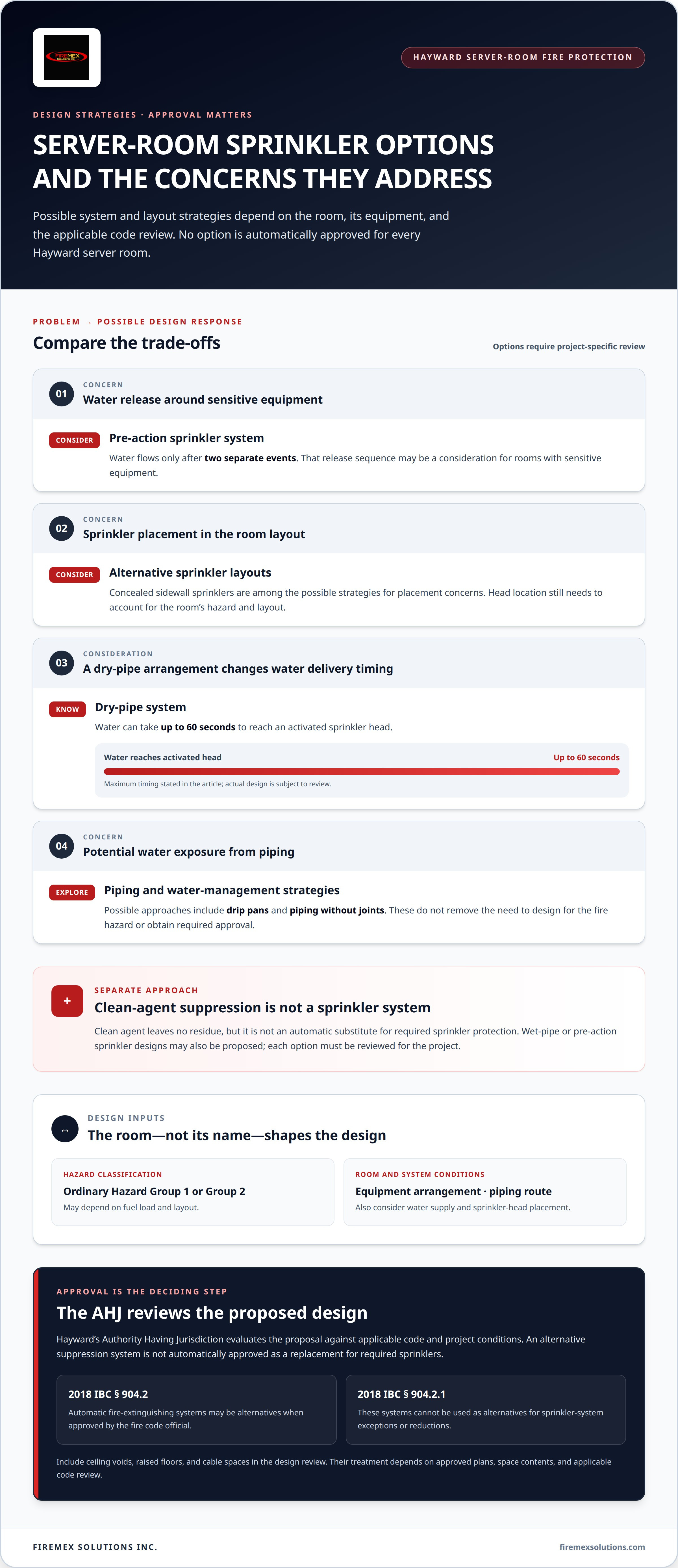
A wet-pipe or pre-action sprinkler design may be proposed, while clean-agent suppression is a separate fire-protection approach. None is automatically approved for every Hayward server room; the AHJ reviews each proposed design against applicable code and project conditions.
An engineer considers the room’s hazard classification, equipment arrangement, piping route, and water supply. IT equipment rooms may be classified as Ordinary Hazard Group 1 or Group 2, depending on fuel load and layout. That classification helps shape sprinkler-head placement and system design. A server-room label alone doesn’t determine which approach fits.
For rooms where owners seek alternatives to conventional sprinkler layouts, possible strategies include concealed sidewall sprinklers, dry sprinklers, drip pans, and piping without joints. Each addresses a different design concern, such as sprinkler placement or potential water exposure from piping. These measures do not eliminate the need to design for the room’s fire hazard or obtain required approval.
Pre-action sprinkler systems require two separate events before water flows, which can be a consideration around sensitive equipment. In a dry-pipe system, water can take up to 60 seconds to reach an activated sprinkler head. Clean-agent suppression leaves no residue, but it is not a sprinkler system and should not be treated as an automatic substitute for required sprinkler protection. A coordinated server-room sprinkler system design can evaluate how proposed piping, suppression, and equipment layout work together.
Approving alternatives to sprinkler protection
An alternative to required sprinklers needs approval under the applicable code pathway; a server-room owner can’t assume another suppression method replaces sprinklers. The 2018 International Building Code, Section 904.2, allows automatic fire-extinguishing systems as alternatives when the fire code official approves them. Section 904.2.1 says these systems can’t be used as alternatives for sprinkler-system exceptions or reductions.
Hayward’s AHJ must determine which provisions apply to the project and whether the proposed alternative supports life safety. The cited International Fire Code exemption, Section 903.3.1.1.1, addresses certain rooms outside specified institutional occupancies when an approved automatic fire detection system complying with Section 907.2 protects them. The cited IFC provision also recognizes rooms where sprinklers may be undesirable because of their contents, subject to fire code official approval.
Ceiling voids, raised floors, and cable spaces do not have one blanket rule for every server room. Their role in the building’s fire-protection design depends on the approved plans, the spaces’ contents, and applicable code review. Include these areas in the proposed design review so the jurisdiction can assess them alongside the occupied room.
For a review, document the proposed system, the areas it protects, and how it addresses the building’s fire-protection and life-safety goals. NFPA 13 provides an automatic sprinkler design standard, but an alternative suppression proposal still needs the required official approval. Plan a code-conscious fire-protection review around the room and its adjoining spaces.
Firemex Solutions
Firemex Solutions Inc. helps property owners turn fire-protection requirements into practical sprinkler-system plans. For a server-room project, its fire sprinkler system design and commercial fire sprinkler systems services support planning for new construction or changes to an existing building. Design can account for the room’s intended use, equipment layout, water supply, and applicable code requirements, aligning the proposed system with the broader building plan.
Turn to Firemex Solutions Inc. when assessing a server-room project, planning sprinkler work, or coordinating system design with construction. The next step is to discuss the building and project scope. Contact Firemex Solutions Inc. for a free estimate on your fire-sprinkler project.
Make the next design decision with confidence
Before planning server-room work, bring the room’s intended use and proposed changes into the design conversation. This gives the project team a clear basis for coordinating fire protection with the building, rather than treating the server room as an isolated space. A thoughtful plan can also clarify which design questions need review before construction begins.
Understanding the fire sprinkler requirements for server rooms in Hayward is a strong starting point; translating them into a project-specific design is the next step. Firemex Solutions Inc. provides commercial fire sprinkler systems and underground fire service, supporting broader building protection needs alongside sprinkler planning.
Contact Firemex Solutions Inc. about your project to discuss the fire-protection work you’re planning. A clear conversation can help you move forward with a steadier path toward a coordinated design.
Frequently Asked Questions
What are the fire sprinkler requirements for commercial properties in the Bay Area & Silicon Valley?
Requirements depend on a property’s size, use, and proposed changes. New commercial buildings in the Bay Area and Silicon Valley that are 3,600 square feet or larger are stated to require sprinklers. For existing buildings, additions or occupancy changes can trigger requirements too. In Hayward, cumulative alterations, additions, or repairs reaching 5,000 square feet are subject to applicable sprinkler provisions.
Can I Omit Sprinkler Protection in Server Rooms?
Not automatically. The cited International Fire Code provision allows a possible exemption for certain rooms outside specified institutional occupancies when an approved automatic fire detection system complying with Section 907.2 protects them. A room where sprinklers are undesirable because of its contents may also qualify for consideration. These are approval pathways, not blanket permission to omit protection from server rooms.
What is NFPA 13?
NFPA 13 is an automatic sprinkler standard identified for data-center sprinkler design. It provides a technical basis for developing a system layout, including how sprinkler protection relates to the space being protected. For a server room, the design still needs to fit the building’s applicable codes and project conditions, rather than relying on the standard name alone.
What California fire codes apply to fire sprinklers in server rooms in Hayward?
Hayward adopted the 2019 California Fire Code, subject to local amendments, and applies California Building Code requirements where relevant. For example, work changing a building’s occupancy or use and resulting in a floor area of 5,000 square feet or more must comply with the most current California Building Code and California Fire Code edition. The project scope determines how those rules apply.
Are there exceptions to sprinkler requirements for data centers or rooms with clean-agent fire suppression?
Possible alternatives require official approval. Section 904.2 of the 2018 International Building Code allows an approved automatic fire-extinguishing system as an alternative to required sprinklers. Section 904.2.1 limits that approach: an alternative system cannot be used to claim sprinkler-system exceptions or reductions. A clean-agent proposal therefore doesn’t, by itself, remove applicable sprinkler requirements.
Comments