


Kitchen Fire Suppression Systems in San Francisco: The 2026 Compliance Guide
San Francisco reached a 10-year high for building fires in 2022; a statistic that underscores why the 2025 San Francisco Fire Code became mandatory on January 1, 2026. If you're managing a commercial kitchen, you know the anxiety of facing an SFFD inspection while balancing California Title 19 requirements. It's a heavy burden to protect your staff and property from grease fires while avoiding the high costs of non-compliance. At Firemex Solutions, we believe you deserve the peace of mind that comes from a professional, safety-conscious approach to kitchen fire suppression systems.
We'll help you master the essentials of Bay Area fire safety, from understanding the 2024 NFPA 96 standards to selecting UL 300 compliant technology that fits your budget. You'll learn how to avoid common violations and ensure your system is "Always Ready..." to prevent property loss. This guide previews the latest installation costs, which range from $8,000 to $25,000 in 2026; it also provides a clear roadmap to achieving A+ service and 100% confidence in your kitchen's protection. We are dedicated to Protecting What MatterS Most!
Key Takeaways
Learn the critical difference between standard sprinklers and specialized kitchen fire suppression systems, including how the science of saponification stops grease fires in their tracks.
Compare appliance-specific designs with flexible overlapping zone protection to find the right balance of safety and versatility for your restaurant's unique layout.
Navigate the SFFD permitting process with confidence by mastering the technical steps from hydraulic calculations to the final professional site survey.
Stay compliant with NFPA 17A and Title 19 by understanding the mandatory semi-annual inspection cycle that keeps your business "Always Ready..." while Protecting What MatterS Most!
Table of Contents Understanding Kitchen Fire Suppression Systems and Bay Area Compliance Choosing the Right System: Design Options for San Francisco Kitchens Installation and Maintenance: Ensuring 100% Confidence
Understanding Kitchen Fire Suppression Systems and Bay Area Compliance
Modern commercial kitchens in the Bay Area operate at high volumes; this requires specialized protection that goes beyond basic plumbing. A kitchen fire suppression system is a dedicated network of nozzles and sensors designed to detect and extinguish high-temperature grease fires within commercial hoods. These Automatic fire suppression systems use wet chemical agents to cool the fire and prevent re-ignition. In 2026, maintaining a UL 300 compliant system isn't just a best practice; it's a legal requirement for insurance coverage and business continuity across San Francisco, San Jose, and Oakland.
Compliance with the SFFD, SJFD, and Oakland Fire Department requires precise engineering. Since fires accounted for 15.7% of non-medical incidents in San Francisco between 2020 and 2022, local inspectors have increased their scrutiny of grease management. Your kitchen fire suppression systems must be "Always Ready..." to handle the unique demands of high-volume wok cooking or charbroiling. Failing to meet UL 300 standards can lead to immediate business shutdowns and total property loss. We provide A+ service to help you meet these rigorous standards while Protecting What MatterS Most!
The Critical Difference Between Building Sprinklers and Hood Systems
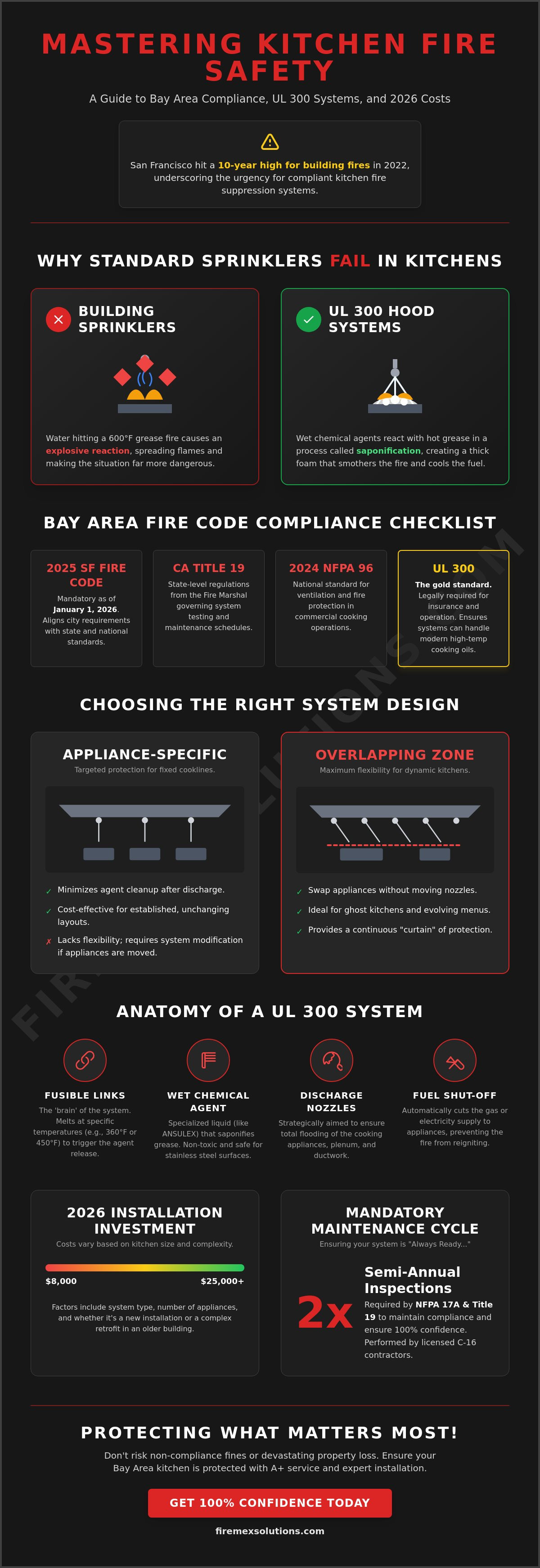
Building sprinklers are designed for structural protection, but they can be dangerous in a kitchen. Water hitting a 600-degree grease fire causes an explosive reaction that spreads flames rapidly. Instead, specialized hood systems integrate with your overall commercial fire protection to provide a focused, chemical response. Saponification is the chemical process where alkaline agents react with hot cooking fats to create a thick, soapy foam that smothers the fire and prevents oxygen from reaching the fuel.
California Title 19 and 2026 Fire Code Updates
The 2025 San Francisco Fire Code became effective on January 1, 2026. This update aligns with California Title 19 and the 2024 NFPA 96 standards. One critical change this year involves mandatory reporting. If your system discharges, you must report it to the SFFD immediately. This ensures every incident is documented and that systems are recharged by licensed C-16 contractors to maintain 100% confidence in your safety. Staying ahead of these regulations prevents the stress of unexpected fines or failed inspections.
Choosing the Right System: Design Options for San Francisco Kitchens
Selecting the right kitchen fire suppression systems depends on your operational flow and the physical constraints of your Bay Area property. For established restaurants with fixed cooklines, appliance-specific designs offer targeted protection that minimizes agent cleanup. However, many high-volume SF eateries now opt for overlapping zone protection. This provides a continuous curtain of agent, allowing you to swap a fryer for a range without moving nozzles; this flexibility is vital as menus evolve. In a city where rent is at a premium, a design that adapts to your equipment saves significant long-term costs.
The NFPA 96 standard dictates how these systems must activate. Mechanical systems rely on tensioned cables and fusible links, while pneumatic systems use pressurized tubing that bursts when exposed to flame. Pneumatic options are often more reliable in kitchens with heavy vibration or complex hood geometries. In Palo Alto and Berkeley, the rise of ghost kitchens has created new challenges. These compact spaces often house multiple cooking brands under one roof, requiring "Design-Build" expertise to ensure every square inch is protected while maintaining 100% confidence in safety.
Key Components: From Fusible Links to Wet Chemical Agents
Fusible links serve as the system's brain; they are designed to melt at specific temperatures, such as 360°F or 450°F, to trigger the discharge. Modern wet chemical agents like ANSULEX are non-toxic and specifically formulated to saponify fats without damaging expensive stainless steel surfaces. The fuel shut-off valve prevents re-ignition by automatically cutting the supply of gas or electricity to appliances the moment the system activates. This immediate response is what provides the A+ service and protection your business needs.
Custom Engineering for Bay Area Renovations
Retrofitting historic buildings in San Francisco requires careful coordination. We often integrate kitchen fire suppression systems with broader fire sprinkler system design to meet modern MEP (Mechanical, Electrical, Plumbing) requirements. This ensures that gas shut-offs and alarm signals communicate perfectly with the building's main panel. If you're planning a tenant improvement, consulting with a C-16 specialist early can save you thousands in rework costs. We provide the expert oversight needed to keep your project on schedule and your kitchen "Always Ready..." for its grand opening while Protecting What MatterS Most!
Installation and Maintenance: Ensuring 100% Confidence
Professional installation of kitchen fire suppression systems begins with a meticulous site survey and precise hydraulic calculations. This phase ensures that agent flow rates meet the specific demands of your cookline. In San Francisco, this process culminates in a final SFFD permit sign-off; a critical step that verifies your system is installed to code. Our team manages the technical heavy lifting, from mounting the cylinders to routing the stainless steel piping, so you can focus on your grand opening with 100% confidence.
Ongoing reliability depends on the semi-annual inspection cycle mandated by NFPA 17A and California Title 19. These every-six-month checkups are vital because they address common points of failure like clogged nozzles, frayed tension cables, or expired chemical cylinders. We also ensure your setup remains compliant with OSHA fire safety regulations regarding fixed extinguishing systems. If a discharge occurs, having a local partner who is "Always Ready..." for an immediate recharge is the difference between a one-day cleaning and a weeks-long business shutdown.
The Certification Checklist for Bay Area Property Owners
Local fire marshals look for specific indicators during surprise safety audits. You must have current service tags visible and digital maintenance logs accessible. Many owners coordinate this with their broader fire sprinkler inspection to streamline compliance and ensure the building's alarm system communicates correctly with the kitchen hood. A failed inspection can result in a $306 re-inspection fee, so getting it right the first time is essential for your budget.
Protecting Your Investment and Lowering Insurance
A certified kitchen suppression system is a powerful tool for lowering commercial property insurance premiums in the Bay Area. Insurers view proactive maintenance as a sign of a low-risk operation, often rewarding compliant businesses with better rates. The long-term ROI of A+ service far outweighs the cost of a single grease fire. By staying ahead of 2026 code updates, you protect your staff, your assets, and your reputation. Protect What MatterS Most with Firemex Solutions Today!
Secure Your Bay Area Kitchen for 2026 and Beyond
Compliance with the 2025 San Francisco Fire Code is about more than avoiding a $306 re-inspection fee; it's about the safety of your team and the survival of your property. You now understand how UL 300 standards and the right design choice, whether appliance-specific or overlapping, keep your operations running smoothly. Maintaining a rigorous semi-annual inspection schedule ensures your kitchen fire suppression systems remain a dependable shield against high-temperature grease fires. Firemex Solutions brings over 20 years of Bay Area fire protection experience to every project we touch. As a C-16 Licensed Contractor, we specialize in navigating the complexities of SFFD mandates and California Title 19 compliance with quiet confidence. We provide the expert oversight required to give you 100% confidence and A+ service for your commercial space.
Get a Professional Kitchen Fire Suppression Quote from Firemex Solutions and let us handle the technical safety details while you focus on your business. We are Always Ready... to help you succeed while Protecting What MatterS Most!
Frequently Asked Questions
Do I need a kitchen fire suppression system if I have a building sprinkler system?
Yes, you definitely need a dedicated hood system. Building sprinklers are designed to protect the structure with water; however, water reacts explosively with grease fires and spreads the flames. Specialized kitchen fire suppression systems use wet chemicals to smother grease fires through saponification. This targeted approach is a requirement under the 2025 San Francisco Fire Code for all operations producing grease laden vapors.
How often are kitchen hood suppression inspections required in California?
Inspections are mandatory every six months according to California Title 19 and NFPA 17A standards. These semi-annual services verify that nozzles aren't clogged and that the chemical agent remains effective. You must also schedule a professional inspection immediately following any system discharge. Keeping digital records or paper tags updated is the only way to pass surprise SFFD audits and maintain 100% confidence in your safety.
What is the difference between UL 300 and older kitchen fire systems?
The UL 300 standard was created to handle modern vegetable oils, which burn at significantly higher temperatures than animal fats used in the past. Older dry chemical systems cannot cool these oils effectively, which often leads to re-ignition. A UL 300 compliant system uses wet chemical agents that offer both rapid cooling and a soapy foam barrier. This technology has been the industry standard since 1994 and is required for all SF commercial kitchens.
Can I install a kitchen fire suppression system myself to save costs?
No, you cannot legally perform this installation yourself in the state of California. The law requires a licensed C-16 Fire Protection contractor to manage the design, installation, and maintenance of kitchen fire suppression systems. Attempting a DIY installation will result in failed SFFD inspections, voided insurance policies, and major legal liabilities. Hiring a professional ensures your kitchen is "Always Ready..." and provides the A+ service needed while Protecting What MatterS Most!
Comments