


Underground Fire Line Installation Bay Area: 2026 Compliance & Expert Guide
Did you know that after the 1906 earthquake, nearly 80% of the property loss was caused by fire, not the shaking itself? In a region where seismic activity is a certainty, your underground fire line installation Bay Area project isn't just about moving water; it's about building a dependable shield for your assets. We know it's stressful to face costly delays from a failed hydrostatic test or confusion over whether a C-16 or C-36 contractor is required for your specific site. You deserve total certainty that your safety infrastructure meets the 2026 California Fire Code.
This guide helps you master the technical requirements and regulatory hurdles of underground fire service. We'll preview the specific material mandates in San Francisco, seismic bracing standards, and the academic-grade engineering needed for a leak-free, code-compliant system. Expert oversight... always.
Table of Contents
Understanding Underground Fire Service Infrastructure in the Bay Area
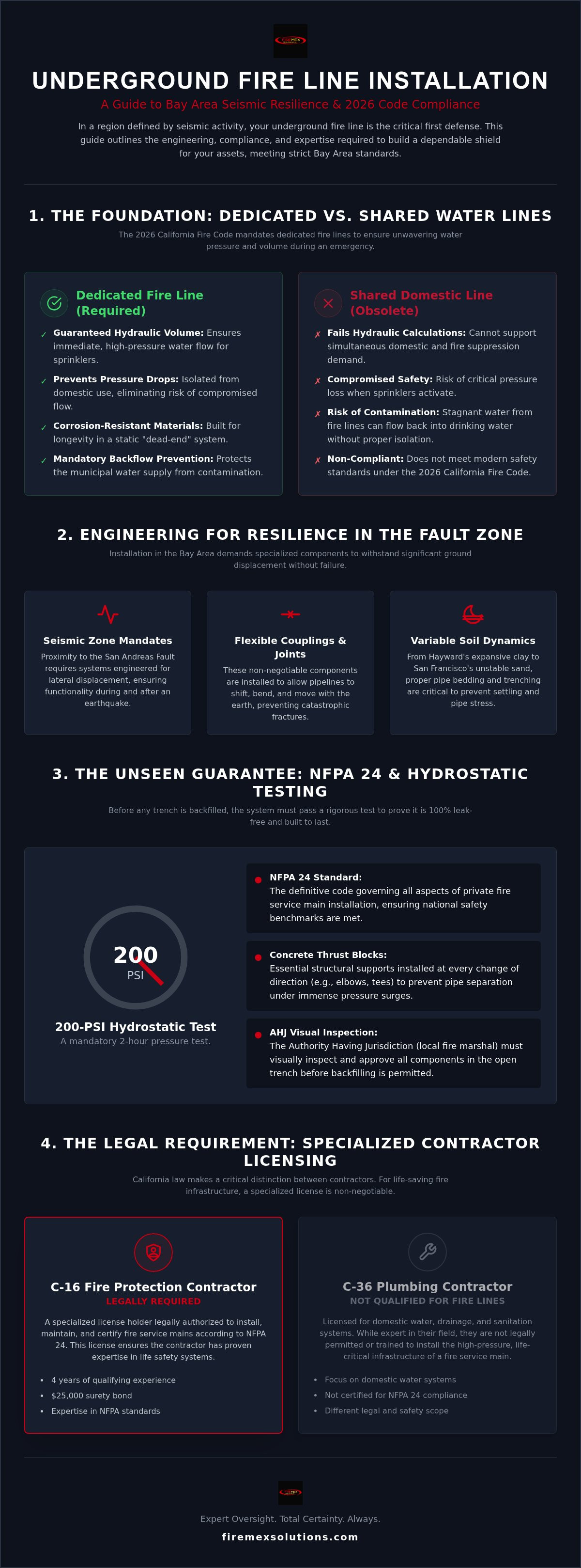
The underground fire line serves as a dedicated, high-pressure pipeline connecting the municipal water main directly to your building's riser. Under the 2026 California Fire Code, standards emphasize the necessity of dedicated fire lines separate from domestic water supplies. This separation ensures immediate hydraulic volume is available during an emergency, preventing the pressure drops that compromise safety in older, shared configurations. For property owners, gaining a professional Understanding Fire Sprinkler Systems starts with this critical underground infrastructure. It's the foundation of a reliable safety shield for your assets.
Think of the fire service main as the essential lifeline for residential fire sprinkler systems and commercial structures. A standard underground fire line installation Bay Area project involves precisely engineered components that must work in unison. These include gate valves for system isolation, backflow preventers to maintain water purity, and the Fire Department Connection (FDC). Every component must be installed with total certainty to withstand the high-pressure demands of a fire event. Expert oversight... always.
The Critical Difference Between Fire and Domestic Water Lines
Shared lines often fail hydraulic calculations during the design-build phase because they can't support the simultaneous demand of domestic appliances and fire suppression. Proper backflow prevention is non-negotiable; it acts as a dependable shield for the municipal water supply against stagnant water. Because fire lines are "dead-end" systems where water remains stationary, utilizing corrosion-resistant materials is vital to prevent internal degradation. This academic-grade approach ensures the system remains functional for decades, providing the peace of mind property owners need.
Engineering for Resilience: Seismic Codes and Bay Area Soil Challenges
The San Andreas fault zone dictates every aspect of underground fire line installation Bay Area. For 2026 projects, engineering must account for significant lateral displacement. In cities like San Francisco and San Jose, flexible couplings and seismic joints are non-negotiable. These components allow the pipeline to shift without fracturing during an earthquake. Without them, a rigid system would likely fail exactly when it's needed most.
Soil dynamics vary wildly across the region. Projects in the East Bay often contend with Hayward clay, which expands and contracts, while San Francisco sites might deal with unstable sand. Proper pipe bedding and trenching stability are critical to prevent settling. Frequently, friction arises between civil engineering plans and the local Fire Marshal’s specific mandates. Reconciling these differences requires a partner who understands the Santa Rosa Fire Department Installation Standards and similar local codes. If you're facing complex site conditions, our team can help you ensure your design meets every safety metric.
Navigating NFPA 24 and the 200-PSI Hydrostatic Test
Compliance culminates in the mandatory 200-psi hydrostatic pressure test. This rigorous two-hour evaluation ensures the system is leak-free before it's hidden underground. To prevent pipe separation under high-pressure surges, the installation of concrete thrust blocks at every change of direction is essential. You must coordinate closely with the Authority Having Jurisdiction (AHJ) for a visual inspection of these components before any backfilling occurs. This academic-grade verification process provides the total certainty that your safety infrastructure is built to last. Reliable protection... always.
Executing a Code-Compliant Installation with Firemex Solutions
In California, the legal distinction between contractors is paramount for safety. While a general C-36 plumber handles domestic water, a C-16 Fire Protection Contractor is legally required for fire service mains. This specialized license demands four years of qualifying experience and a $25,000 surety bond. Choosing a partner with over 20 years of experience for your underground fire line installation Bay Area project ensures that every joint and valve meets the NFPA 24 Standard. At Firemex, we integrate commercial fire protection from the municipal street main directly to the sprinkler head.
Local expertise in cities like Palo Alto and Mountain View is vital for navigating specific municipal amendments. These nuances often cause costly permit delays for inexperienced teams who don't understand local soil or burial depth variations. Once the line is buried, ensuring long-term reliability requires a commitment to ongoing professional fire sprinkler inspection. This proactive approach keeps your system ready for its critical moment. Responsive support... always.
The Value of Total Certainty in Fire Safety Infrastructure
Firemex acts as your "Reliable Guardian" by overseeing every phase, from engineering and excavation to final hydrostatic testing. We provide academic-grade documentation that acts as a verbal seal of quality for your 2026 system certification. This level of oversight alleviates the stress of compliance for property owners. Your next step involves coordinating the underground service with the building's overall fire suppression design. By aligning these phases early, you'll ensure a code-compliant result that's built to last. Expert oversight... always.
Building a Resilient Safety Shield for Your Property
Protecting your investment starts with a foundation that can withstand both the 2026 regulatory environment and the unique seismic challenges of Northern California. Dedicated infrastructure, precise material selection, and rigorous hydrostatic testing form the basis of a resilient safety system. A successful underground fire line installation Bay Area project requires a partner who understands the high stakes of fire protection and the nuances of municipal codes. Firemex Solutions brings over 20 years of Bay Area safety expertise to every project. As a C-16 Licensed Fire Protection Contractor, we ensure your installation is fully compliant with 2026 California Fire Codes. We provide the total certainty and academic-grade oversight necessary to move your project from excavation to final certification without stress.
Secure your building’s foundation with Firemex Solutions... We're ready to protect what matters most.
Frequently Asked Questions
How deep does an underground fire line need to be buried in the Bay Area?
Burial depth for an underground fire line installation Bay Area project depends on pipe size and local municipal amendments. In San Francisco, lines two inches or smaller require a minimum depth of 12 inches below finished grade with specific concrete cover. For larger pipes, the requirement is typically 2.5 feet deep. Always verify requirements with the local Authority Having Jurisdiction in cities like Oakland or San Jose.
Can any plumbing contractor install a fire service main in California?
No, a general C-36 plumbing contractor cannot legally install a fire service main in California. This work requires a specialized C-16 Fire Protection Contractor license. The state mandates this because fire lines are high-pressure safety systems that must follow strict NFPA 24 standards. Hiring a licensed C-16 professional ensures your system is engineered correctly and satisfies all legal safety requirements for your property.
What is a hydrostatic test, and why is it required for underground fire lines?
A hydrostatic test is a rigorous pressure evaluation where the underground line is pressurized to 200 psi for two hours. This test is mandatory to confirm the system is leak-free and can withstand high-pressure surges during an emergency. It provides total certainty that every joint and fitting is secure before the trench is backfilled. Failing this test often leads to expensive and time-consuming excavation repairs.
Do I need a separate underground line for fire sprinklers and domestic water?
Yes, the 2026 California Fire Code generally requires dedicated fire lines separate from domestic water supplies for most commercial and large residential projects. Dedicated lines ensure that the hydraulic volume needed for fire suppression isn't compromised by domestic water use. This separation also prevents stagnant water from the fire system from contaminating the municipal drinking water supply, fulfilling critical backflow prevention standards for Bay Area municipalities.
Comments