


Underground Fire Line Installation Bay Area: The 2026 Property Owner’s Guide
A failed municipal inspection isn't just a scheduling hiccup; it's a costly setback that can stall your entire project for months. You've likely felt the stress of trying to distinguish between general civil excavation and the specialized engineering required for life safety systems. It's frustrating when different water districts like SFPUC and EBMUD have conflicting rules for backflow preventers and pipe depths. This guide simplifies the process of underground fire line installation Bay Area, ensuring you meet the 2026 California Fire Code standards without the usual headaches.
We understand that your goal is a leak-free, code-compliant system that satisfies the Authority Having Jurisdiction (AHJ) on the first attempt. You'll learn the technical requirements for material mandates, the specifics of the hydrostatic test, and how to coordinate perfectly between the city water main and your building riser. Let's ensure your property remains protected and your project stays on track.
Table of Contents
Navigating Bay Area Fire Codes for Underground Infrastructure in 2026
The underground fire line serves as the critical high-pressure link between the municipal main and your building's internal fire riser. It's a lifeline. For any property owner planning an underground fire line installation Bay Area, staying current with NFPA 24 standards is vital for legal and safety compliance. The underground fire service is a dedicated pipeline engineered to handle the high-volume water demands of a suppression system.
Updated 2026 California Fire Code standards mandate a clear separation between domestic water lines and fire service lines. This separation guarantees hydraulic priority, ensuring that your safety system receives the necessary pressure even when domestic demand peaks. This active fire protection method provides a reliable shield for your assets only if the infrastructure meets these rigorous engineering benchmarks. Working with an experienced fire protection company near me helps bridge the gap between municipal water supply and building life safety.
Seismic Standards and Soil Requirements for Local Districts
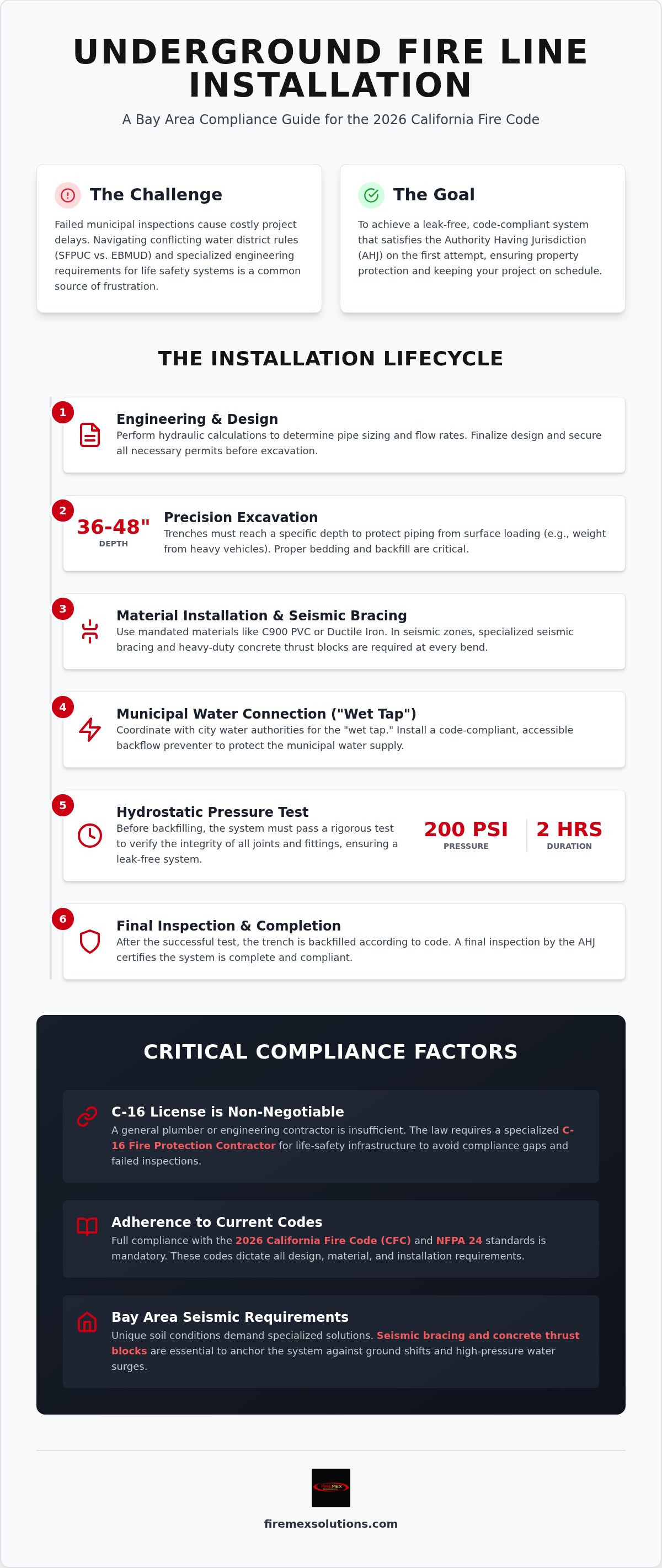
San Francisco and the surrounding Peninsula present unique challenges due to varying soil stability. To combat potential shifts, local codes require specialized seismic bracing and heavy-duty concrete thrust blocks at every bend. These components anchor the system against the immense force of high-pressure water surges. Material requirements also differ by city. While some jurisdictions permit C900 PVC, others demand ductile iron for its superior durability in seismic zones. Coordinating with a fire engineering company during the design phase ensures your material choices align with local mandates, preventing costly rework during the inspection phase.
The Installation Lifecycle: From Civil Excavation to Hydrostatic Testing
Success starts with a comprehensive site survey and close coordination with a fire engineering company. They perform the hydraulic calculations that determine pipe sizing and flow rates. This data ensures the system handles the specific demands of your property. Once the design is finalized and permits are secured, the physical work begins.
The excavation phase for an underground fire line installation Bay Area requires precision. Trenches must typically reach a depth of 36 to 48 inches. This depth isn't arbitrary; it protects the piping from surface loading issues, such as the weight of heavy vehicles passing overhead. Proper bedding and backfill are equally critical to prevent pipe deflection or damage over time.
Before the system is covered, it must pass a rigorous 2-hour hydrostatic pressure test, usually conducted at 200 psi. This verifies the integrity of every joint and fitting. Adhering to California Fire Code (CFC) Chapter 9 during this phase is mandatory for final certification. Understanding the fire sprinkler system inspection requirements helps property owners maintain this compliance long after the initial installation.
Coordinating with SFPUC, EBMUD, and Local Water Authorities
Managing the "wet tap" connection to the city main involves navigating different rules for districts like SFPUC or EBMUD. These connections often require city-approved contractors and specific permits. Consider this checklist for a smooth connection:
Verify if the water district requires their own crews or an approved third-party contractor.
Ensure the backflow preventer is placed in a code-compliant, accessible enclosure.
Confirm the exact location of the municipal main before trenching begins.
A backflow preventer is essential to protect the municipal water supply from contamination. It must be located where it's easily accessible for annual testing. If you're feeling overwhelmed by these technical hurdles, consulting a professional can offer total certainty.
Why a C-16 License is Vital for Underground Fire Service Installation
Hiring a general plumber for your fire service is a risk you simply can't afford. There's a sharp legal and safety distinction between a standard plumbing contractor and a specialized fire protection company near me holding a C-16 license. While a general engineering contractor might handle broad excavation, they often lack the technical depth required for life-safety infrastructure. This "compliance gap" is the leading cause of failed building inspections in the Bay Area, as inspectors look for specific NFPA 24 adherence that generalists might overlook.
A C-16 specialist ensures that your underground fire line installation Bay Area matches the hydraulic requirements of your overhead system exactly. At Firemex, we adopt a "Reliable Guardian" approach. We don't just bury pipe; we engineer a permanent safety link designed to perform under extreme pressure. The process concludes with essential system certifications, providing you with the documentation needed for city sign-off and insurance compliance. This academic-grade precision is what distinguishes a professional installation from a standard utility job.
The Firemex Advantage: Reliability for Bay Area Property Owners
We bring over 20 years of industry experience to every project. We've mastered the specific permit hurdles and inspection nuances in San Francisco, San Jose, and Oakland. Our team anticipates local water district demands before they become delays, ensuring a seamless coordination between the street and the building. Choosing a seasoned professional means you're investing in long-term fire protection. It's about more than passing a test; it's about total certainty that your property and its occupants are shielded by a code-compliant, high-performance system.
Securing Your Property with Expert Fire Service Infrastructure
Mastering the complexities of underground fire line installation Bay Area requires more than just digging trenches. It demands a deep understanding of the 2026 California Fire Code and the technical precision of NFPA 24 standards. We've explored how proper excavation depths and rigorous hydrostatic testing ensure your system remains a dependable shield for years to come. Relying on a C-16 licensed specialist isn't just about passing an inspection; it's about the total certainty that your life safety infrastructure is engineered for peak performance.
With over 20 years of local expertise, Firemex Solutions Inc. serves as your reliable guardian against compliance stress and technical delays. We prioritize your safety and budget through academic-grade oversight and a commitment to honesty. Ensure your project meets 2026 fire codes with Firemex Solutions Inc. and take the first step toward a code-compliant, worry-free installation. Your property deserves the highest standard of protection.
Frequently Asked Questions
How deep does an underground fire line need to be buried in the Bay Area?
An underground fire line in the Bay Area typically requires a burial depth between 36 and 48 inches. This depth protects the piping from the weight of vehicles and seismic activity common in cities like San Francisco and Oakland. While local codes like the San Francisco Plumbing Code specify minimum cover, following NFPA 24 standards ensures your infrastructure remains secure and passes municipal inspections on the first attempt.
Can any plumbing contractor install a fire service main in San Francisco?
No, not every plumber is legally permitted to handle this specialized work. In California, a C-16 Fire Protection Contractor license is mandatory for installing and servicing fire sprinkler systems and their underground mains. Hiring a specialist from Firemex Solutions Inc. prevents the compliance gaps that occur when general contractors lack the specific life-safety engineering expertise required for 2026 code adherence.
What is a hydrostatic test, and why is it required for underground fire lines?
A hydrostatic test is a high-pressure integrity check where the underground fire line installation Bay Area is pressurized to 200 psi for two hours. This procedure verifies that every joint is leak-free and capable of handling extreme water surges during an emergency. It's a mandatory requirement for final certification and ensures your property is shielded by a code-compliant, reliable system.
Do I need a separate underground line for fire sprinklers and domestic water?
Yes, modern 2026 standards require a dedicated line for fire service that is separate from your domestic water supply. This separation guarantees hydraulic priority, ensuring your suppression system has immediate access to the necessary water volume during an emergency. It removes the risk of pressure drops caused by domestic demand, providing a higher level of safety for Bay Area property owners.
Comments