


Fire Sprinkler Maintenance Bay Area: Ensuring Compliance and Safety
- Aug 1
- 9 min read
Your fire sprinkler system is not a passive safety feature. It's a living, pressure-dependent network that can fail silently, and when it does, the consequences reach far beyond a compliance notice. For property owners across the region, fire sprinkler maintenance Bay Area regulations aren't just bureaucratic paperwork; they're the legal framework standing between your building and a catastrophic loss.
If you've ever felt unsure about the difference between an inspection and actual maintenance, or worried about finding a licensed C-16 contractor you can genuinely trust, you're not alone. Those concerns are exactly what make this topic feel so overwhelming for so many building owners and facility managers.
This guide cuts through that confusion. You'll walk away with a clear understanding of what California's NFPA 25 and Title 19 standards actually require of you, what separates a routine inspection from a full maintenance protocol, and what to look for in a qualified contractor who can protect your property for the long term. Consider this your practical roadmap to total peace of mind.
Table of Contents
Understanding Fire Sprinkler Maintenance Requirements in the Bay Area
Fire sprinkler maintenance is not a single event on a calendar. It's a proactive, ongoing regimen of testing, servicing, and repairing system components to ensure they perform exactly as designed when a fire occurs. That distinction matters enormously, because many property owners conflate maintenance with inspection, and that misunderstanding creates real legal exposure.
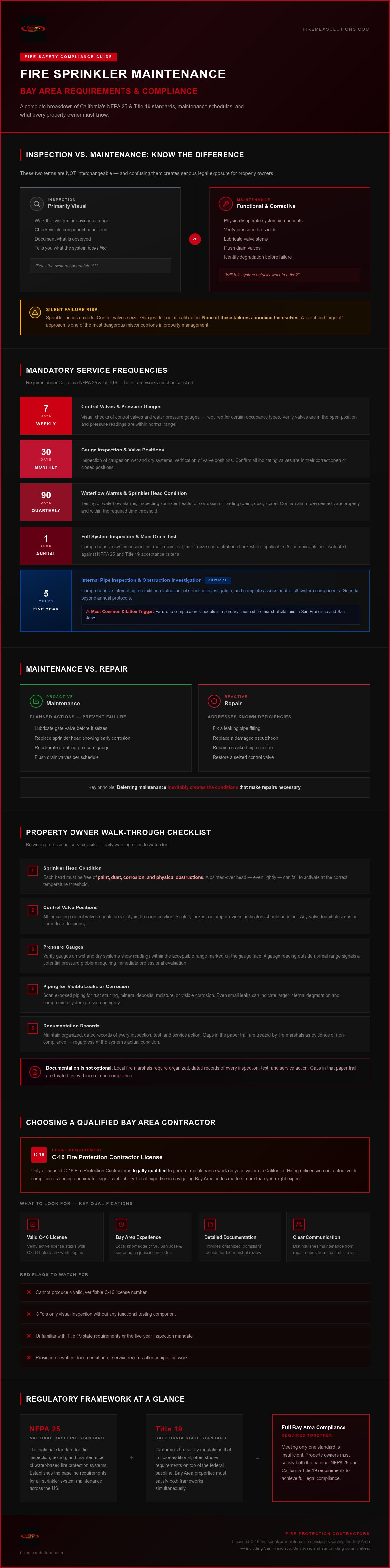
An inspection is primarily visual. A trained technician walks the system, checks for obvious damage, and documents what they observe. Maintenance is functional and corrective. It involves physically operating components, verifying pressure thresholds, lubricating valve stems, flushing drain valves, and identifying degradation before it becomes a failure. One tells you what a system looks like. The other tells you whether it will actually work.
Treating your fire suppression system as "set it and forget it" infrastructure is one of the most dangerous misconceptions in property management. Sprinkler heads corrode. Control valves seize. Gauges drift out of calibration. None of these failures announce themselves, which is precisely why a structured maintenance program exists.
The Legal Stakes: NFPA 25 and California Title 19
Effective fire sprinkler maintenance Bay Area compliance is governed by two overlapping frameworks: NFPA 25, the national standard for the inspection, testing, and maintenance of water-based fire protection systems, and California Title 19, the state's fire safety regulations that impose additional, often stricter requirements on top of the federal baseline.
Together, they establish mandatory service frequencies that property owners must meet:
Weekly: Visual checks of control valves and water pressure gauges in certain occupancy types
Monthly: Inspection of gauges on wet and dry systems, verification of valve positions
Quarterly: Testing of waterflow alarms, inspecting sprinkler heads for corrosion or loading
Annually: Full system inspection, main drain test, anti-freeze concentration check where applicable
California also mandates a Five-Year Inspection, a cornerstone compliance requirement that goes well beyond annual protocols. This involves internal inspection of pipe condition, obstruction investigation, and a comprehensive evaluation of all system components. Failing to complete this inspection on schedule is one of the most common triggers for fire marshal citations in cities like San Francisco and San Jose.
Documentation is not optional. Local fire marshals require organized, dated records of every inspection, test, and service action. Gaps in that paper trail are treated as evidence of non-compliance, regardless of the system's actual condition.
Maintenance vs. Repair: Knowing the Difference
Maintenance is planned. It's the lubrication of a gate valve before it seizes, the replacement of a sprinkler head showing early signs of corrosion, or the recalibration of a pressure gauge drifting outside its acceptable range. These are deliberate actions taken to prevent a failure from occurring.
Repair is reactive. It addresses a known deficiency, a leaking fitting, a damaged escutcheon, a cracked pipe section, that has already compromised system integrity. Both are essential, but they're not interchangeable. Deferring maintenance inevitably creates the conditions that make repairs necessary. For property owners dealing with a specific system defect, our guide on residential fire sprinkler repair Bay Area covers the repair process in detail.
Understanding which category your system needs at any given moment is the foundation of responsible ownership, and it's exactly the kind of clarity a qualified contractor should provide from the first site visit.
Essential Maintenance Checklist for Bay Area Property Owners
Adopting a Reliable Guardian mindset means you don't wait for a licensed technician to tell you something is wrong. Between professional service visits, property owners can and should conduct structured walk-throughs that catch early warning signs before they become code violations or system failures. This isn't about replacing professional fire sprinkler maintenance Bay Area services; it's about being an informed steward of your own building.
Start with your sprinkler heads. Each one should be free of paint, dust, corrosion, and physical obstructions. A head that's been painted over, even lightly, can fail to activate at the correct temperature threshold. Check that nothing is stored within 18 inches below any head, and verify that no heads appear bent, cracked, or mechanically damaged. These are visual checks anyone can perform.
Control valves deserve equal attention. Every valve in your system should be fully open and locked or sealed in that position. Closed or partially closed valves are among the most common causes of system failure during a fire event. Confirm that each valve has legible, posted signage identifying its function. If a valve is missing its tamper indicator or seal, that's a documented deficiency requiring professional attention.
Don't overlook your spare sprinkler head cabinet. California code requires that a supply of spare heads matching your installed types be stored on-site, along with the appropriate installation wrench. If that cabinet is empty, disorganized, or missing entirely, your property is already out of compliance.
Environmental Challenges in San Francisco and Coastal Cities
Properties in San Francisco, Pacifica, and Redwood City face a threat that inland buildings largely avoid: salt air corrosion. The marine layer that defines Bay Area coastal weather accelerates oxidation on exposed metal components, particularly older steel pipe systems and uncoated sprinkler heads. Humidity fluctuations compound this by causing pipe joints to expand and contract repeatedly, weakening seals over time. Micro-corrosion, the gradual internal pitting of pipe walls invisible to the naked eye, is a silent threat to older Bay Area residential systems that standard visual inspections simply won't catch.
The "Walk-Through" Routine: What to Look For
During your routine walk-through, check every pressure gauge on your wet system. Normal operating range is typically around 175 psi, though your system's design documents will specify the exact acceptable range for your installation. A gauge reading significantly above or below that range warrants a call to your contractor before the next scheduled visit.
Loading: In kitchens, garages, and mechanical rooms, inspect heads for accumulated grease, dust, or debris. This "loading" insulates the heat-sensitive element and delays activation. It's especially common in commercial food service spaces.
Corrosion indicators: Look for rust staining, white mineral deposits, or discoloration around pipe fittings and head escutcheons.
Valve position confirmation: Every control valve should be visibly open. If you're unsure, don't assume.
Obstruction clearance: Verify that new shelving, equipment, or inventory hasn't been placed in a way that blocks sprinkler coverage patterns.
For a complete breakdown of what licensed inspectors evaluate during formal compliance reviews, the fire sprinkler inspection guide covers full compliance details specific to San Francisco and surrounding jurisdictions.
If your walk-through surfaces anything beyond a simple observation, it's time to bring in a professional. A qualified C-16 contractor can assess whether what you've spotted is a maintenance item or a repair need, and document it correctly for your compliance records. Contact Firemex Solutions to schedule a professional assessment before a minor finding becomes a fire marshal citation.
Choosing a Reliable Guardian for Your Bay Area Fire System
Knowing what your system needs is only half the equation. The other half is ensuring the right person performs the work. For fire sprinkler maintenance Bay Area property owners, that means one thing: a licensed C-16 Fire Protection Contractor, and nothing less.
Why a C-16 License is Non-Negotiable
California law is unambiguous on this point. Only a contractor holding a C-16 Fire Protection license is legally authorized to design, install, or maintain fire sprinkler systems in the state. This isn't a formality. It's a qualification that requires demonstrated knowledge of hydraulic calculations, code compliance, and life-safety engineering standards that general contractors and handymen simply don't possess.
Allowing an unlicensed individual to perform "quick fixes" on a life-safety system creates compounding risks: voided insurance coverage, invalid compliance documentation, and a system that may appear functional while harboring a critical deficiency. The consequences of that shortcut surface during a fire, not during a walk-through.
Verifying a contractor's license status takes less than two minutes. Visit the California Contractors State License Board (CSLB) website at cslb.ca.gov, search the contractor's name or license number, and confirm that the C-16 classification is active and in good standing before any work begins.
The Firemex Solution: 20 Years of Bay Area Safety
Local expertise isn't a marketing phrase. It's the difference between a contractor who knows San Francisco's fire marshal documentation preferences and one who doesn't. Firemex Solutions Inc., based in South San Francisco, has spent over 20 years building that institutional knowledge across the Bay Area's residential and commercial landscape.
Their service suite covers the full spectrum of fire sprinkler maintenance Bay Area needs: residential and commercial system maintenance, underground fire service, system design, repair, and official system certifications. Critically, their approach treats each building as an individual engineering challenge rather than a templated service call. Pipe routing, occupancy type, water supply conditions, and local code nuances all factor into how maintenance is planned and executed for your specific property.
That project-based discipline, applied consistently over two decades, is what separates a genuine Reliable Guardian from a contractor simply running through a checklist.
Ensure your system is ready when it matters most. Contact Firemex Solutions Inc. for a maintenance consultation today.
Your Building Deserves a System That's Ready
Fire sprinkler maintenance Bay Area compliance isn't something you can afford to treat as a background task. The regulatory framework is real, the consequences of non-compliance are serious, and the silent nature of system degradation means problems rarely announce themselves before they become critical.
Three things matter most here: understanding the difference between inspection and genuine maintenance, staying ahead of your compliance obligations through structured walk-throughs, and partnering with a contractor who's legally qualified and locally experienced. Cut corners on any one of them, and the other two lose their value.
Firemex Solutions Inc. brings over 20 years of Bay Area expertise, a C-16 license, and deep familiarity with the specific code requirements that govern properties across the region. They don't just service systems; they protect the people and assets inside your building.
Don't wait for a fire marshal citation to take your system seriously. Secure your property with professional maintenance from Firemex Solutions Inc. and move forward with genuine confidence in your building's safety.
Frequently Asked Questions About Fire Sprinkler Maintenance in the Bay Area
How often does a fire sprinkler system need maintenance in California?
California requires maintenance at multiple intervals, not just once a year. Under NFPA 25 and Title 19, certain occupancy types require weekly or monthly gauge checks, quarterly waterflow alarm tests, and a full annual inspection including a main drain test. Beyond that, a mandatory Five-Year Inspection covers internal pipe condition and obstruction investigation, and missing that deadline is one of the most common triggers for fire marshal citations.
The specific schedule for your building depends on your system type, occupancy classification, and local jurisdiction requirements. A licensed C-16 contractor can map out the exact compliance calendar for your property so nothing falls through the cracks.
Can I perform fire sprinkler maintenance on my own Bay Area home?
No. California law reserves fire sprinkler maintenance work exclusively for licensed C-16 Fire Protection Contractors. Attempting maintenance yourself, or hiring an unlicensed handyman, risks voiding your insurance coverage, generating invalid compliance documentation, and leaving hidden deficiencies undetected. These aren't hypothetical risks; they're the documented consequences that surface when a system fails during an actual fire event.
What homeowners can do is conduct structured visual walk-throughs between professional visits, checking for painted-over heads, valve positions, clearance distances, and obvious corrosion. Those observations are valuable, but they don't substitute for licensed fire sprinkler maintenance Bay Area professionals performing the functional, corrective work your system legally requires.
What happens during a 5-year fire sprinkler inspection and test?
The Five-Year Inspection goes significantly deeper than a standard annual visit. A licensed technician conducts an internal examination of pipe condition, looking for corrosion, pitting, and scale buildup that external checks simply can't reveal. The process also includes a formal obstruction investigation, a comprehensive evaluation of all system components, and verification that the system's hydraulic performance still meets its original design specifications.
All findings are documented in a detailed report that must be retained for your compliance records. If deficiencies are identified, they're classified by severity so you understand exactly what requires immediate correction versus what can be scheduled. Skipping or delaying this inspection is a compliance failure regardless of how well your system appears to be functioning.
What are the signs that my fire sprinkler system needs immediate repair?
Certain conditions require a call to a licensed contractor without delay. These include visible water staining or active leaks around pipe fittings, pressure gauge readings that fall significantly outside your system's specified range, any control valve that isn't fully open, and sprinkler heads that are cracked, bent, or show heavy corrosion. A tripped or missing tamper seal on a valve is also a documented deficiency that needs professional attention right away.
Don't underestimate subtler signs either. Rust-colored water from a drain test, unusual pressure fluctuations, or heads with visible loading from grease or debris all indicate conditions that maintenance alone may not resolve. When in doubt, treat the observation as a repair need and get a qualified assessment before your next scheduled service visit.
Comments